
The Ritual of Stewardship – Dave Myers and NCWF Lake Norman Wildlife Chapter’s Work for Wildlife
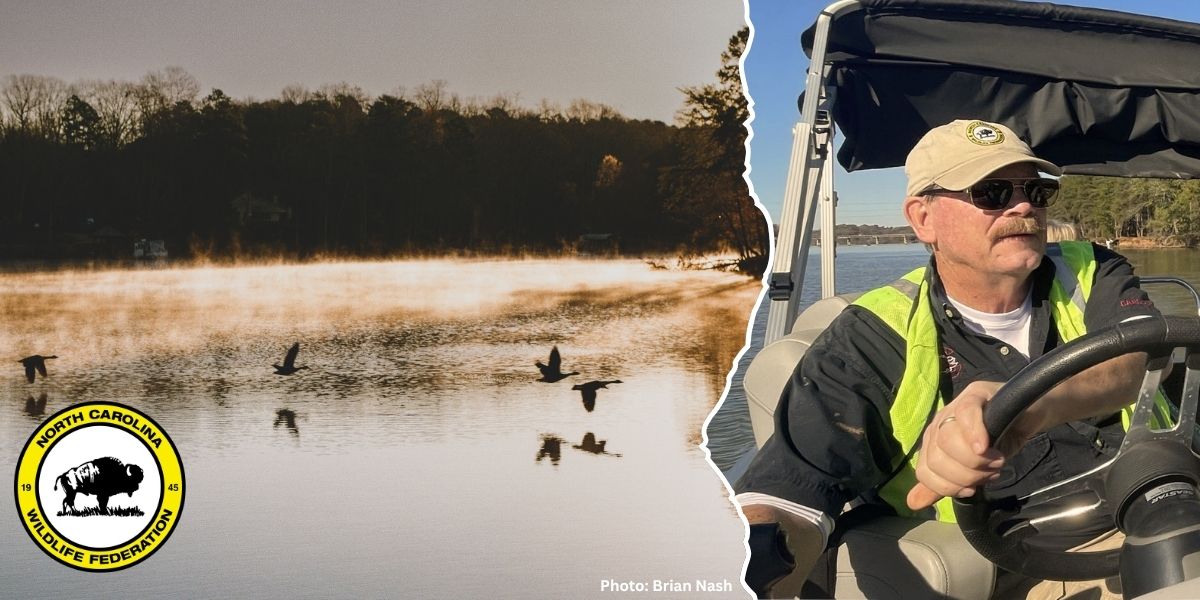
You can learn a lot about a conservationist by asking where their connection to wildlife and habitat first began.
Often, it starts with something simple – a fascination with animals at the zoo, a favorite place to explore in the outdoors, the simple joy of playing in the woods with friends as a child.
But just as often, that connection deepens into something more lasting through loss. A neighboring woodlot cleared for development. The tragic sight of dead animals lining the highway roadside. The quiet disappearance of the birdsong you used to hear every day.
Somewhere between that love and subsequent loss, concern becomes conviction. Because while every conservationist starts in a different place, many share the same realization: the natural world they care about is not guaranteed to remain.
For Dave Myers, it began with water.
Long before Lake Norman became a destination – before its shorelines filled with homes and boat traffic – it was simply “the river” to those who grew up alongside it. For Dave, the youngest of four siblings raised in Charlotte, that river was both playground and classroom. His family’s early days camping along the shoreline in the 1960s slowly gave way to something more permanent – a shelter, then a lake house, and eventually a lifelong connection to the water that still shapes his days.
As a kid, Dave’s world stretched as far as a half tank of gas could carry him. He spent hours exploring coves, creeks, and wooded edges, learning the rhythms of the lake through experience rather than instruction.
Back then, the water was clearer, the shoreline quieter, and the presence of wildlife was more obvious. Picking up trash wasn’t a chore – it was simply part of being there.
“Having fun involved picking up the occasional piece of trash in the water or on the shore,” Dave says. “This fun became a habit, then a ritual as I grew older.” It was a small, almost incidental act that became something enduring – one of the earliest threads in a conservation ethic that would stay with him and, over time, extend beyond him. “As a child, I wanted to keep the lake clean,” he adds, “and I’ve since passed that habit on to my kids and grandkids.”
Lake Norman Wildlife Conservationists Chapter
That mindset carried forward into adulthood. In the 1980s, Dave began supporting North Carolina Wildlife Federation as a donor, reading the quarterly journals and staying loosely connected to the work. At the time, his role was informal – less about participation and more about alignment.
It wasn’t until retirement approached that conservation took on a more active form. A conversation with a neighbor led to an introduction to Billy Wilson, president of the NCWF Lake Norman Wildlife Chapter, and an opportunity to assist with a fish reef project on Lake Norman.
From there, involvement came naturally.
What began as a single project grew into deeper engagement, as Dave stepped into leadership and helped guide the chapter through a period of renewed energy and focus.
That momentum was tested – and strengthened – when Hurricane Helene left its mark on the Lake Norman area, creating both devastation and urgency. In response, the NCWF Lake Norman Wildlife Chapter mobilized quickly, organizing a large-scale cleanup effort that brought together volunteers, partner organizations, and local stakeholders.
“Collecting about 75,000 pounds of debris was a big project,” Dave says, “which engaged many local volunteers and reignited our local chapter.”
It reinforced something he had believed all along: conservation doesn’t have to start big. It just has to start.
Even now, his connection to the lake remains rooted in the details. The return of spring marked by blooming dogwoods – his favorite tree, an annual signal of the Carolina season ahead. The quiet presence of great blue herons along the shoreline. The seasonal arrival of osprey and loons.
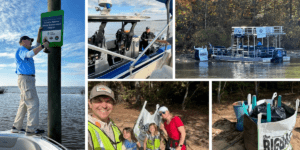
November 2, Hurricane Helene Cleanup: NCWF Lake Norman Wildlife Conservation Chapter completed its second major lake cleanup in response to Hurricane Helene. Volunteers and boat captains deployed from two separate access areas and removed over 15,000 lbs of trash and debris with the help of over 30 volunteers, 7 boats, and heavy equipment from Lancaster Custom Dock and Lift. Volunteers even took the time to inspect osprey platforms for damage and to fasten Duke Energy & NCWF Habitat Enhancement Program informational signs to the poles.
At the same time, he recognizes the pressures facing North Carolina’s natural spaces. Growth and development, while inevitable, come at a cost. “The reasons I personally like North Carolina also bring other people in and spur rapid growth,” he notes. “The resulting development continues to reduce habitat and displace or concentrate wildlife into smaller areas.”
Still, he holds a clear vision for the future. “I hope to see a future where conservation is fully integrated into how we live and grow – where protected lands are expanded, and communities actively value and participate in preserving North Carolina’s natural heritage.”
And while the challenges are complex, his advice remains simple and grounded in practice.
“Start by joining a local like-minded conservation group – or just in your own backyard,” he says. “Clean up trash, remove invasive plants, plant native plants. Then do it again. It becomes a habit and, through repetition, a wildlife-supporting ritual is created.”
At its core, his perspective centers on the everyday actions that often go unnoticed, but are truly what make change for wildlife possible.
“The real heroes and role models to me are the folks who pick up trash and do the right conservation thing when no one knows,” he says. “These folks – and our volunteers – are the true heroes in my mind.”
That collective effort has not gone unrecognized. As a result of their work, the Lake Norman Wildlife Chapter was named NCWF Community Wildlife Chapter of the Year at the 61st Annual Governor’s Conservation Achievement Awards.
“Our Chapter and I are quite proud and humbled by this recognition,” Dave says. “We have made some good progress recently in re-energizing both our Board and volunteers, yet this has also shown us how much more we can and need to do.”
Every conservation story begins somewhere.
For Dave, it began with water, and a love of place. What started as a child’s simple act of picking up trash became something deeper over time.
Because somewhere between that early connection and the changes he’s witnessed since, care became conviction. And like the water that first shaped it, that conviction continues to move forward – steadily, persistently, a shared ritual that continues shaping what comes next.
You can reserve your seat for NCWF’s 61st Governor’s Conservationist Achievement Awards ceremony on May 2nd at Embassy Suites in Cary, NC to celebrate NCWF Lake Norman Wildlife Chapter and other conservation heroes across the state. Reserve your seat.
Written by:
– Bates Whitaker, NCWF Creative Content Manager