It’s Not a Swine Time in North Carolina – The History and Ecological Impact of Feral Swine
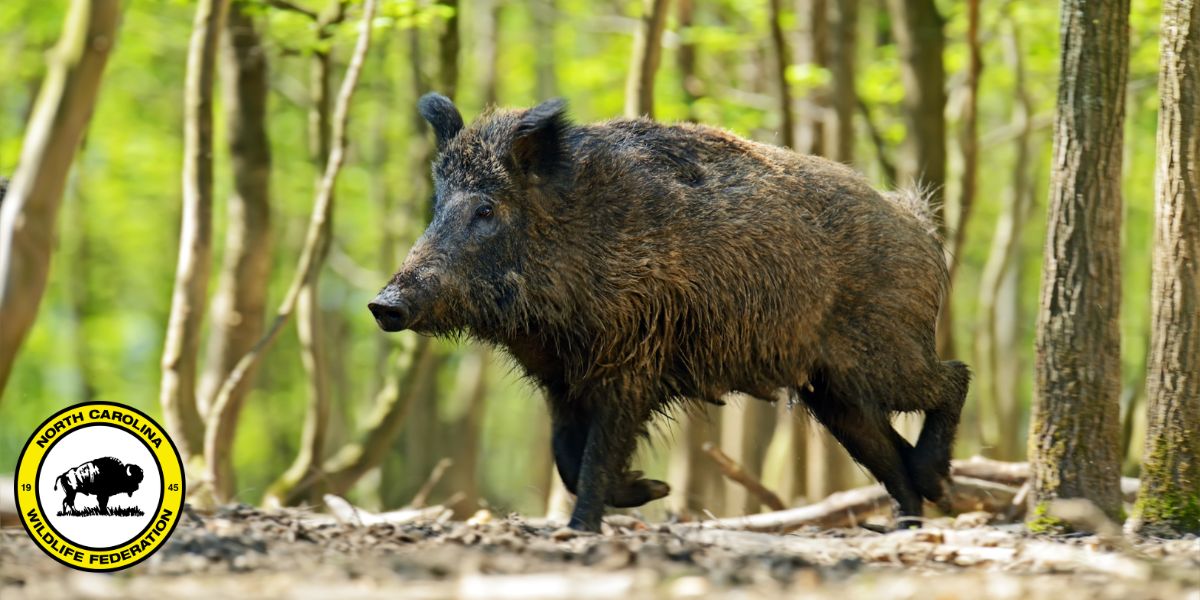
The story of feral swine is one of scarcity and abundance—of animals once prized and welcomed as livestock, but now an ecological menace. It’s a story bound up in North America’s hunting heritage, the introduction of exotic species, international trade, European colonization—and, surprisingly, even The Great Gatsby.
This is the story of feral swine in North Carolina.
What Are Feral Swine?
Feral swine are complex creatures. Even the term itself can be confusing; they’re also known as wild pigs, wild boar, or feral hogs—terms often used interchangeably. All pigs fall under the species Sus scrofa, which also includes domestic pig breeds. Feral swine are free-ranging members of this species that have reverted to a wild state, descending from domestic pigs, Eurasian wild boar, or hybrids of the two.
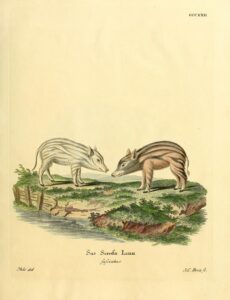
Image: Wild boar piglets, Biodiversity Heritage Library
Pigs have been part of human life for millennia. Ancient Greeks and Romans hunted wild boar, and pig domestication began around 8,500 to 8,000 BCE in the Near East. This long history is key to understanding their presence in the U.S. Pigs weren’t native to North America; European settlers brought them as a food source in the 1500s, allowing them to roam freely.
According to author and environmental engineer Alice Outwater, hogs were considered by settlers to be “cattell for proffeit,” and, due to pigs being forest dwellers before domestication, were primed to prosper in the woods of the eastern U.S. Over time, some escaped or were intentionally released, quickly adapting to the wild and becoming feral. Wild pigs were often prized over the pigs kept in enclosures, with the early 1700s English explorer John Lawson noting that, “The Pork that runs wild is much better than the tame, being more juicy and better tasted, and a Belly of Wild Pork is a Dish for an Emperor.”
Within months, domestic pigs released into the wild begin to exhibit physical and behavioral changes, making the transition to feral swine remarkably fast. This initial introduction would go on to have profound impacts on North American ecosystems, agriculture, and culture. Even as early as 1709, Lawson noted in A New Voyage to Carolina that, “The Hogs are very numerous in [North] Carolina, running in great Droves in the Woods, and feeding on the Mast of the Oaks.”
Notably, as it pertains to culture, hogs played a role in a cultural shift connected to Indigenous relationships to the land. The Narragansett sachem Miantonomo lamented and predicted in 1642, “You know, our fathers had plenty of deer and skins, our plains were full of deer, as also our woods, and of turkies, and our coves full of fish and fowl. But these English, having gotten our land, they with scythes cut down the grass, and their hogs spoil our clam banks, and we shall all be starved.”
This prediction resulted in just the expected outcome: hogs played a critical role not only in the destruction of native habitats, but also in the erosion of Indigenous foodways and culture.
Boar Hunting and the Spread of Feral Swine

A 17th century engraving by artist Adriaen Collaert depicting a wild boar hunt. Image sourced from Europeana.
While pigs first arrived with settlers, the modern feral swine problem is deeply tied to early 20th-century boar hunting culture. In the early 1900s, wealthy landowners began importing wild pigs for sport, often hunting them with dogs.
One notable figure in early 20th-century boar hunting was George Gordon Moore, a Canadian socialite believed to be the inspiration for F. Scott Fitzgerald’s Jay Gatsby, linking feral swine history to a broader cultural narrative. In 1912, Moore established a European-style game preserve on 1,600 acres near Hooper Bald in western North Carolina, introducing 14 wild boar along with other exotic game.
This introduction near Hooper Bald marked the beginning of a persistent feral swine population in the southern mountain region of the state. That population remains today and is one of the most established populations in the state, illustrating how such introductions can have long-lasting persistence and ecological consequences. But such introductions were not the first to establish the species in the North Carolina landscape.
As early as 1733, North Carolina’s governor George Burrington wrote that some “fifty thousand fatt hoggs are supposed to be driven into Virginia from this Province & almost the whole number of fatted Oxen in Albemarle County with many Horses, Cows and Calves, much barreled Pork is carried into Virginia.” This illustrates the practice of moving these animals across the landscape, further dispersing them.
Similar boar transport occurred across the U.S., and populations were further protected when feral swine were legally designated as game species in several states. In North Carolina, legal protections began to emerge by 1969. In Jackson and Transylvania counties, they were designated as game animals, with hunting seasons and bag limits. These protections expanded in 1979 when the North Carolina Wildlife Resources Commission (NCWRC) classified these animals as big game statewide— ironically helping populations grow.
A major shift occurred in 2011 when feral swine were reclassified as a nongame invasive species, lifting restrictions and allowing year-round hunting with no bag limits. The state soon permitted night hunting and later ended the formal wild boar season in western counties, moving from game management to eradication efforts.
Impacts On Habitat
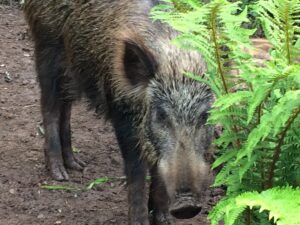
Image: River Wye Foresters
Feral swine inflict serious ecological damage. Their rooting behavior destroys native plants, disrupts soil, and unearths insects, while wallowing damages wetlands and vernal pools. They compete with native herbivores like deer for food, and their omnivory contributes to the decline of ground-nesting bird populations and amphibians. They are opportunistic feeders, eating everything from plants and small animals to the young of ground-nesting birds like quail and turkey—and even the occasional deer fawn. Larger reptiles like snakes, lizards, and turtles are also subject to feral swine consumption.
In agricultural settings, swine destroy crops, erode stream-banks, and contaminate water sources. By disturbing soil and defecating near waterways, feral swine increase sedimenta tion and introduce pathogens like E. coli and leptospirosis into streams and ponds. Nationwide, according to the U.S. Department of Agriculture’s Animal and Plant Health Inspection
Service (USDA APHIS), they cost an estimated $1.5 billion annually in damages and control efforts. This estimate is
based on a conservative calculation of $300 in damage and control costs per hog, applied to an estimated population of 5 million feral swine across the country. With current national feral swine numbers exceeding 6 million, annual economic
losses could well exceed $2 billion per year.
Beyond economic costs, feral swine reduce the aesthetic and recreational value of parks and properties, damage infrastructure, and displace native wildlife that rely on the same habitats.
Challenges in Managing Feral Swine
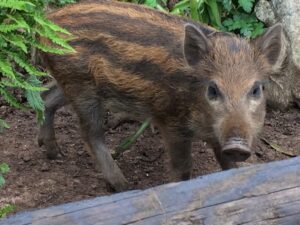
Image: River Wye Foresters
Feral swine management is notoriously difficult. These animals reproduce at an alarming rate—females can birth two litters per year, with up to a dozen piglets each, and reach sexual maturity before their first birthday. At this rate of reproduction, a single female may produce over a hundred piglets in her lifetime. Under favorable conditions, populations can double in just a few months, far outpacing most control efforts.
While recreational hunting traditionally played a perceived role in management, it’s rarely successful enough to reduce or eliminate swine populations. According to the USDA’s National Feral Swine Damage Management Program, at least 70 percent of a local swine population must be removed each year to simply maintain current numbers, much less achieve a reduction. Hunting alone typically removes far fewer individuals, and may make pigs more elusive, driving them to become nocturnal or scatter into smaller, harder-to-catch groups.
In response, state and federal agencies use advanced tools like infrared drones, trail cameras, and remote-activated corral traps. These traps—designed to capture entire sounders (groups of adult swine with their young) at once—are currently the most effective strategy for reducing feral swine numbers. However, control delays often result in quick rebounds.
Recognizing the need to address issues related to feral swine, the N.C. General Assembly has proposed language in the 2025 Farm Act that charges a coordinated action by forming the N.C. Feral Swine Working Group. This group brings together state wildlife agencies, state agriculture agencies, scientists, landowners, policy makers, and others to share data for the hiring of personnel necessary to implement feral swine damage control activities and provide outreach, education, and technical support. Future success of the removal of feral swine from the landscape depends heavily on landowner participation and adequate funding from the N.C. General Assembly for the program.
Despite efforts, feral swine continue to expand their range, threatening North Carolina’s ecosystems, agriculture, and rural livelihoods. Long-term control will require consistent funding, public engagement, and a shared commitment to remove this invasive species from the landscape.
Disease Risks
North Carolina is the nation’s third-largest pork producer, generating over $10 billion annually and supporting tens of thousands of jobs, particularly in rural areas. Feral swine pose a serious threat to this critical industry. They are known carriers of more than 30 diseases and nearly 40 parasites, many of which can infect livestock, pets, wildlife, and even humans.
Of particular concern are brucellosis (which causes reproductive failure and can infect humans), pseudorabies (fatal to cattle, sheep, and dogs), and African swine fever, a highly contagious and economically devastating disease not yet present in the U.S. but spreading globally. Feral pigs’ rooting and wallowing behavior allows for easy contamination of water sources, farm equipment, and pastures. Infected wild pigs can also transmit diseases indirectly to domestic herds through contaminated feed, surfaces, or via boots and clothing.
Once disease enters domestic herds, containment is costly and challenging, potentially triggering trade restrictions, mass culling, and long-term damage to consumer confidence. The mobility, high reproduction rate, elusiveness of feral swine, and mixed support from private landowners make disease surveillance and management exceptionally challenging.
The future of feral swine in North Carolina remains uncertain but what is clear is their legacy—a potent combination of ecological destruction, economic disruption, and public health risk. Their presence is a cautionary tale about the consequences of introducing and failing to control nonnative species in new ecosystems.
Written by:

– Bates Whitaker, NCWF Creative Content Manager