Game Species and Red Wolves: A Path to Coexistence on Private Lands – Guest Blog
Guest blog written by Luke Lolies, Fish and Wildlife Biologist, US Fish and Wildlife Service
In Hyde County, North Carolina, private landowner Jeff Akin is proving that conservation and hunting can go hand in hand. Through the U.S. Fish and Wildlife Service’s Partners for Fish and Wildlife (PFW) Program, Jeff has embraced habitat management practices that support both game species and the federally endangered red wolf.
Improving Habitat for Game Species and Red Wolves
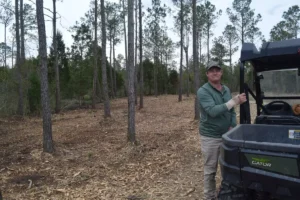
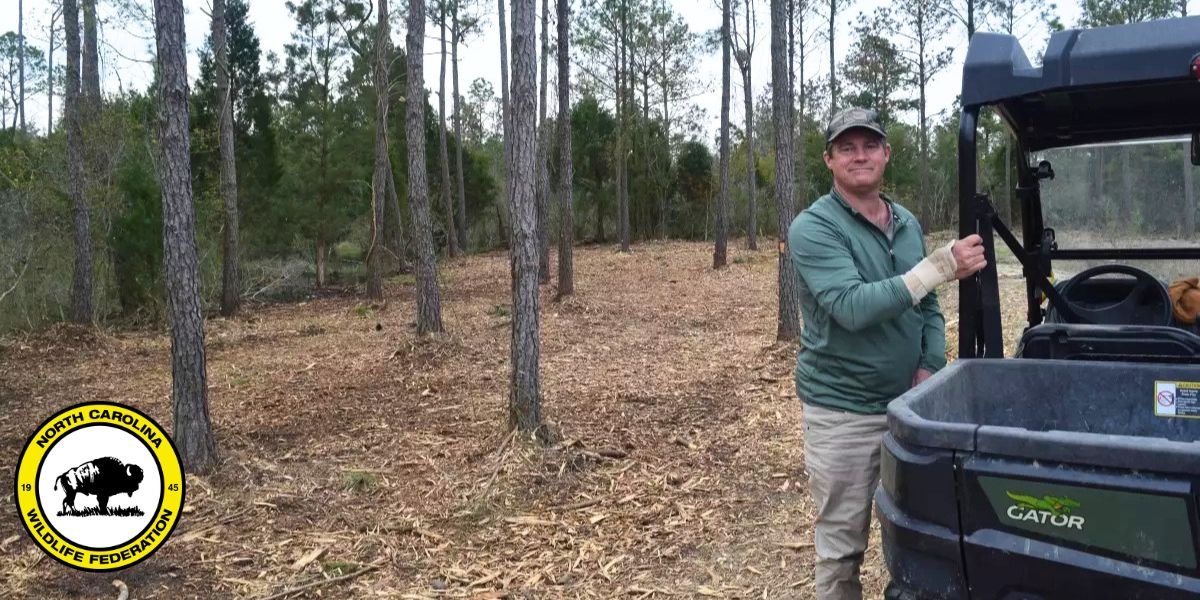
Private landowner Jeff Akin stands in a newly mulched forest understory on his property in North Carolina—part of habitat improvements supported by the Partners for Fish and Wildlife Program to benefit both game species and the federally endangered red wolf.
By participating in the Prey for the Pack initiative—a habitat improvement initiative led by the PFW Program in collaboration with the North Carolina Wildlife Federation to help recover the federally endangered red wolf—Jeff has enhanced early successional vegetation, boosting food and cover for deer, rabbits, and other small mammals. These improvements benefit hunters and red wolves alike, creating a shared landscape where both can thrive.
With support from PFW Program biologist Luke Lolies, Jeff implemented a combination of mulching and prescribed burning across 25 acres to improve early successional vegetation. The mulching removed a dense hardwood midstory that was blocking sunlight from reaching the forest floor, limiting the development of the understory. The prescribed fire then consumed the decomposing mulch and leaf litter, creating the conditions needed for native grasses and forbs to regenerate and thrive.
A Model of Private Lands Leadership
Jeff’s work is a powerful example of how private landowners can play a vital role in wildlife conservation. His collaboration with the PFW Program demonstrates that with the right tools and partnerships, it is possible to maintain strong hunting traditions while supporting the recovery of the red wolf.
To learn more about red wolf conservation and the Prey for the Pack initiative, visit the U.S. Fish and Wildlife Service’s Red Wolf Recovery Program website and North Carolina Wildlife Federation’s blog.