

A Legacy of Land and Water: Katherine Skinner Inducted into North Carolina’s Conservation Hall of Fame
Each year, NCWF recognizes conservation champions across North Carolina for their dedication to protecting, conserving, and restoring the state’s wildlife and habitats.
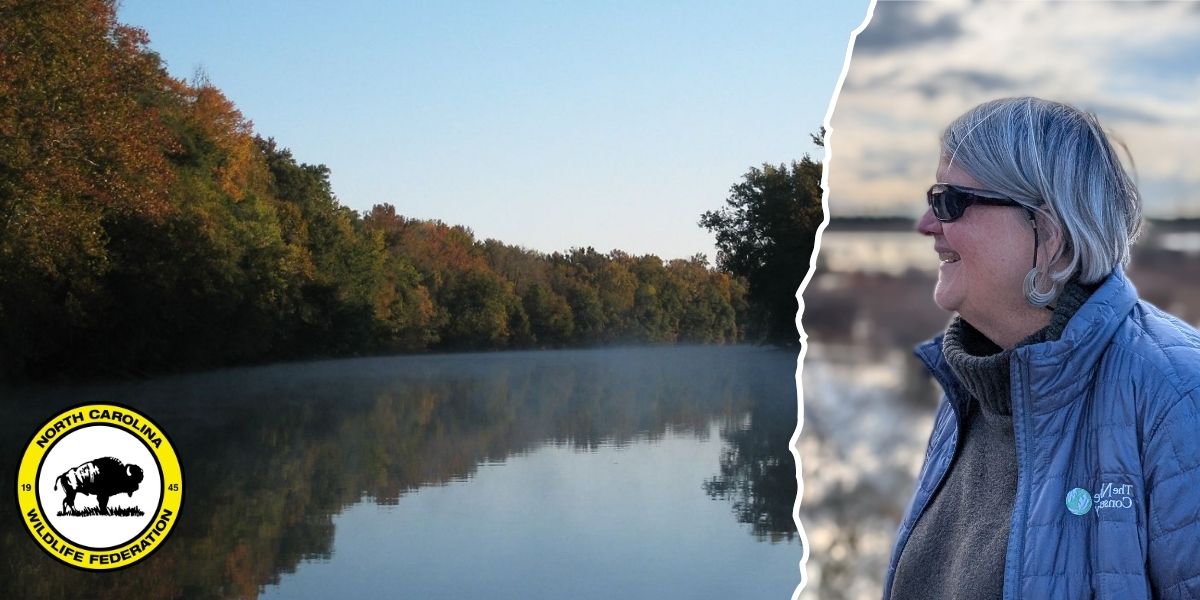
The Conservation Hall of Fame is reserved for those who have exhibited long-term service in the cause of wildlife and wildlife habitat conservation, education, and conservation outreach in North Carolina. Induction into the Hall of Fame is reserved for those individuals whose service is exemplary, steadfast, and impactful – and few embody that impact as strongly as Katherine Skinner, NCWF’s Conservation Hall of Fame inductee. Katherine will be inducted and recognized for her years of service at NCWF’s upcoming 61st Annual Governor’s Conservation Achievement Awards.
Katherine Skinner’s visionary leadership has transformed land and water conservation through her tenure as Executive Director of The Nature Conservancy in North Carolina, protecting more than 460,000 acres and contributing to 745,000 acres conserved statewide. She championed ecologically significant landscapes including the Amphibolite Mountains, longleaf pine ecosystems, the Roanoke River corridor, and critical coastal habitats. Skinner advanced durable conservation funding through the Natural Heritage Trust Fund, the Clean Water Management Trust Fund (now the NC Land and Water Fund), and the Parks and Recreation Trust Fund, directing over a billion dollars toward conservation projects. She strengthened partnerships with state and federal leaders to secure major federal investments, including EPA Climate Pollution Reduction funding for peatland restoration. Through collaborations with the military, agencies, nonprofits, and private landowners, Skinner safeguarded critical wildlife habitat, restored freshwater and coastal ecosystems, and enhanced public access. Her work ensures North Carolina’s natural heritage will endure for generations to come.
We spoke with Katherine about her deep commitment to conservation, the growing challenges facing wildlife and habitat in North Carolina, and the long-term, collaborative work required to address them.
You can reserve your seat for NCWF’s 61st Governor’s Conservationist Achievement Awards ceremony on May 2nd at Embassy Suites in Cary, NC. Don’t miss this opportunity to participate in the celebration of conservation heroes across the state. Reserve your seat.
Katherine Skinner, NCWF Conservation Hall of Fame Inductee
Q: What is your favorite native wildlife species and why?
Katherine Skinner: It has to be the rare sandhill crane. They are much more plentiful on the Central Flyway, but you can have a rare sighting at the Pungo Unit in Pocosin Lakes National Wildlife Refuge.
I think it’s one of the most majestic birds out there, and I had the undying pleasure to go to Nebraska earlier this year to see their migration. It was minus 15 degrees out there, and it brought to mind the Jimmy Buffett song where he says, “And now I wish I was somewhere other than here”!
But jokes aside, it was absolutely worth it to see the cranes. It was stunningly phenomenal.
Q: Where are you from and how did you get to where you are today?
Katherine Skinner: I grew up in a little town called Williamston in Northeastern North Carolina. I lived there until I went to college, then left and traveled around the United States and Europe, doing odd jobs before I went back to school for a Master’s of Business Administration from Vanderbilt.
Then I went to work for the US Congress for six years, on the House Committee on Merchant Marine and Fisheries. While I was there, The Nature Conservancy had a big project in the committee chair’s district, and it was assigned to me. I got to know the organization, and I really liked the work they did and how they did it. It was a group I just wanted to belong to.
When the Executive Director position for The Nature Conservancy in North Carolilna came open, I went to lunch with the person who I had worked with to create the Currituck National Wildlife Refuge, and he told me how to apply for the position. Long story short, I ended up getting the job, and I’ve gladly been here ever since.
Q: What drives your passion for wildlife and conservation?
Katherine Skinner: Results. We get results. And I believe we’re also making the world a little bit of a better place, and certainly making North Carolina a better place.
This state will look different in 30 years than it looks right now, and it looks different now than it did 30 years ago. But I’m passionate about the work of the conservation community, the protection of our state parks, our game lands, our national wildlife refuges, our national parks, the amount of open space and functioning river systems… it all really does matter.
Q: What has been the most rewarding aspect or a particularly significant highlight from your career up to this point?
Katherine Skinner: In the 1990s and early 2000s, we started factoring a climate lens into our conservation strategies – more around adaptation than anything else – but we began looking at it much more seriously.
Then you fast forward to around 2014, when the Nature Conservancy and Environmental Defense Fund got a $30 million grant from the MacArthur Foundation to educate people about climate change. We brought together EDF’s policy strength and our bipartisan conservation approach and worked with trusted voices that the community would be receptive to.
After Hurricanes Florence and Michael, Governor Cooper formed multiple task forces, and we helped develop plans on housing, coastal resilience, floodplain management, and natural climate solutions. The work the environmental community put into those task forces laid the groundwork for our ability to apply for the Climate Pollution Reduction Grant.
When Michael Regan became EPA Administrator, a climate pollution reduction grant opportunity emerged. North Carolina partnered with Maryland, Virginia, and South Carolina, and we built a coalition that developed a $421 million proposal focused on natural climate solutions – and we won. It became the largest environmental grant in North Carolina’s history and for the Nature Conservancy. It was a big undertaking and a huge accomplishment for the conservation community in North Carolina.
Q: What do you see as the top conservation challenges facing North Carolina and how can they be addressed?
Katherine Skinner: I would say it’s climate change and population growth. North Carolina has 12 million people living in this state. We’re the third-largest growing state in the country. You’ve got to have the resources for people to live here, but you’ve also got to have the resources for ecosystems and natural communities to function. And so that’s the line we walk, and addressing both of these issues successfully takes working together.
Q: Who are your conservation heroes?
Katherine Skinner: We are all each other’s heroes. Not one of us stands by his or herself alone in this work. We are a community. I’m not the team; I am a member of a team.
So my heroes are the people who put their nose to the grindstone, solve the big issues, work through the problems, and figure out a way to get to a good result.
For instance, we’re in a coalition with the National Wildlife Federation, the Conservation Fund, and the local land trusts called Land for Tomorrow. We’re managing the resources coming out of the North Carolina General Assembly to methodically put together good conservation efforts around core places in this state to create wildlife corridors, parks, healthy riverine systems, healthy ecosystems.
This type of work is where I find my heroes. Everyone there is doing the work. I’d say we’re each other’s heroes.
Q: What does it mean to you to be inducted into the Conservation Hall of Fame?
Katherine Skinner: I was surprised to be inducted, but deeply honored to celebrate the work we’ve done together in North Carolina.
I’m also very blessed to join Margaret Nygard in the Conservation Hall of Fame. I knew Margaret – she was a force of nature- and it’s a high honor to be alongside her in the in the Hall of Fame.
Q: If you could give one piece of advice to others passionate about conservation, what would it be?
Katherine Skinner: It would be this: Follow your passion, but be smart about how you do it. Recognize the enabling conditions that you do or don’t have, and how to make that work for the end result.