


Masters of Disguise – Mimicry, Masquerade, and More Wildlife Camouflage Tactics
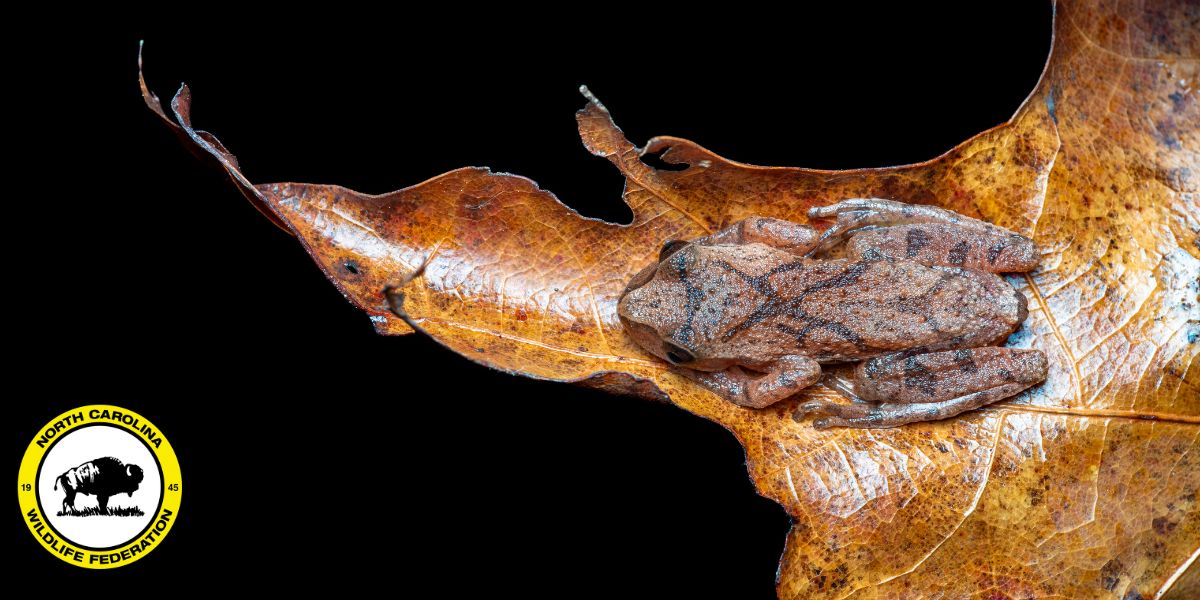
Maybe you’re lucky enough to have walked through a patch of woods and flushed an unseen covey of quail just a foot in front of you, or nearly stepped on a perfectly hidden white-tailed deer fawn resting on the sun-dappled forest floor.
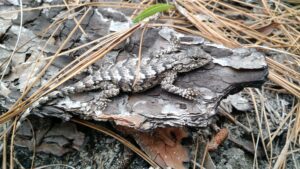
Eastern fence lizard by Kerry Brust, NCWF Photo Contest Submission
Or maybe you’ve spotted a fence lizard on a pine tree, basking in the sunlight and blending in almost perfectly with the bark beneath it.
Maybe you’ve picked out a small twig on the end of a branch that seems to be moving just a little more than the rest… only to realize it’s actually a walking stick insect.
Regardless, these examples – and many others – are wildlife camouflage at work. The ability to blend in with the surrounding environment is a trait shared by many species, shaped over generations to help them survive in their habitats.
There are many reasons why animals blend into their surroundings and many benefits these abilities provide. In this blog post, we’ll explore several camouflage strategies, why they are important, and how you can learn to spot even the most well-hidden masters of disguise.
Why Does Wildlife Camouflage?
Humans rarely need to camouflage themselves in the natural environment – aside from hunters, wildlife photographers, or military personnel. Because of this, many people don’t realize how essential camouflage is for wildlife and the many purposes it serves.
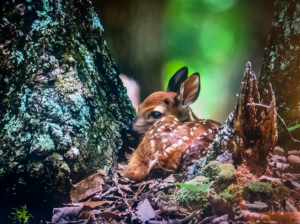
White-tailed deer fawn by Danna Cable, NCWF Photo Contest Submission
Here are a few reasons animals rely on camouflage.
Avoiding predators (crypsis):
Blending into the environment helps animals avoid being seen and eaten by predators. Many species rely on camouflage as their primary defense. For example, the mottled brown feathers of a northern bobwhite blend into leaf litter and understory vegetation. Young animals can also benefit from camouflage adaptations that may shift as they get older, a strategy known as ontogenetic camouflage. White-tailed deer fawns, for instance, have dappled coats that resemble sunlight filtering through leaves, helping them remain hidden from large predators such as coyotes and bobcats.
Hunting prey (aggressive camouflage):
Some predators use camouflage to approach prey without being detected. Coyotes, hawks, and owls often rely on muted coloration that allows them to blend into grasslands, forests, or shadows while stalking prey.
Ambush strategies:
Other species rely on remaining completely still while they wait for prey to come within striking distance. Animals such as copperheads or snapping turtles depend on camouflage and patience to capture unsuspecting prey.
Mimicry and masquerade:
Some species avoid detection by resembling objects in their environment. Phasmids – also fittingly called stick insects or walkingsticks – look remarkably like twigs, and katydids often resemble leaves. By mimicking these natural objects, these animals reduce the chance of being noticed and preyed upon by predators.
How Wildlife Camouflage Works
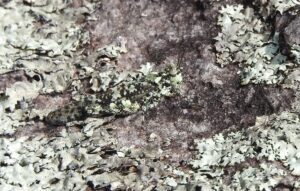
Lichen grasshopper by Alex McCall, NCWF Photo Contest Submission
Animals use a variety of strategies to blend into their surroundings.
Color matching (background matching):
Many species have colors that closely resemble the environments where they live. Through color matching, browns, grays, and greens allow animals to blend into tree bark, leaf litter, sand, or grass. This is one of the most common forms of camouflage and is used by many birds, reptiles, mammals, and insects.
Disruptive coloration:
Some animals have bold patterns such as stripes, spots, or contrasting patches that break up the outline of their bodies, referred to as disruptive coloration. These patterns make it harder for predators – or prey – to recognize the animal’s true shape, even when it is in plain sight.
Countershading:
In a countershading camouflage strategy, an animal’s back is darker while its underside is lighter. Because sunlight usually comes from above, this coloration reduces shadows and makes the animal appear flatter and less visible from a distance.
Mimicry:
Certain species resemble or mimic something else in their environment, such as a leaf, twig, or piece of bark. Others mimic animals that predators avoid. This deception helps them remain unnoticed or discourages predators from attacking.
Texture and body shape:
Some animals rely on their physical shape or surface texture to blend in. Rough skin, flattened bodies, or leaf-like edges can help an animal resemble the surfaces around it.
Behavioral camouflage:
Camouflage is not always just about appearance – it’s sometimes about behavior. Through behavioral camouflage, animals may remain perfectly still, strategically position themselves along branches, or sway gently like a leaf in the wind. These behaviors can make them even harder to detect.
Which Species Camouflage and How to Spot Them
Green Anole
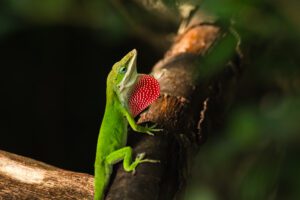
Green anole by Gavin Shwahla, NCWF Photo Contest Submission
Green anoles (Anolis carolinensis) are the only native lizards in North Carolina capable of significant and rapid color changes, earning them the nickname “American chameleons.” Their coloration can shift between bright green and brown depending on temperature, stress levels, lighting, predation attempts, social interaction, and humidity. These changes occur through specialized pigment cells called chromatophores.
Camouflage Strategies
- Background matching (crypsis)
When green anoles are bright green, they blend well with leaves and vegetation. When they turn brown, they more closely match tree bark, branches, or dead leaves. This helps them avoid predators such as birds and snakes. - Context-dependent color change
Although their color change is not seasonal like some animals, it is a rapid physiological response that can enhance camouflage depending on the environment. - Partial masquerade
When a brown anole sits motionless along a branch or twig, its body shape and coloration can make it resemble part of the tree itself. While not as extreme as a walking stick insect, it still creates a subtle masquerade effect.
Green anoles are easiest to spot while basking on fences, tree trunks, and shrubs. During the breeding season – generally from April through September – males become even easier to notice. Male green anoles display a bright pink or red throat fan called a dewlap, which they extend to establish territory, warn rivals, and attract mates.
Eastern Copperhead
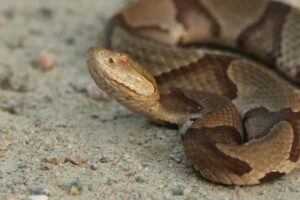
Eastern copperhead by H Allan White, NCWF Photo Contest Submission
Eastern copperheads (Agkistrodon contortrix) are one of North Carolina’s most recognizable snakes, but they are also among the easiest to overlook because of their excellent camouflage. Their tan to copper-colored bodies are marked with dark brown hourglass-shaped bands that blend well with fallen leaves on the forest floor.
These adaptations allow copperheads to rely on several types of camouflage.
Camouflage Strategies
- Background matching (crypsis)
Copperheads closely match the browns and tans of dry leaf litter. When resting among fallen leaves, their coloration allows them to blend almost perfectly into the forest floor. - Disruptive coloration
The snake’s hourglass-shaped bands break up the outline of its body, making it more difficult to distinguish the snake’s shape when it is coiled or partially covered by leaves. - Ambush camouflage
Copperheads are ambush predators that often remain motionless while waiting for prey such as mice, frogs, or insects to pass nearby. Their ability to stay perfectly still, combined with their camouflage, allows them to hunt effectively without being noticed.
Because of this camouflage, copperheads are often only noticed when they move. When walking in wooded areas, it’s helpful to watch the ground ahead and look for the distinctive hourglass pattern among the leaves.
Northern Bobwhite
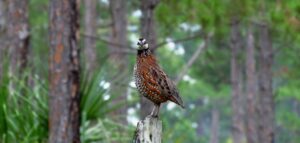
Northern bobwhite by YoungSue (Susan Young)
The northern bobwhite (Colinus virginianus) is a small ground-dwelling bird well known for its distinctive “bob-white” call. While these birds inhabit fields, forests, and brushy habitats, they are often surprisingly difficult to see.
Northern bobwhites have mottled brown, buff, and gray feathers that closely resemble grasses, soil, and leaf litter where they spend much of their time.
Camouflage Strategies
- Background matching (crypsis)
The quail’s speckled brown plumage blends well with dry grasses and leaf litter. When a quail crouches low to the ground, it can become nearly indistinguishable from its surroundings. - Disruptive coloration
The complex pattern of spots and streaks on a quail’s feathers breaks up the outline of its body, making it harder for predators to identify the bird’s shape in dense vegetation. - Behavioral camouflage
Bobwhites often rely on stillness as their first defense. Instead of immediately flying away, they frequently remain motionless when danger approaches and only retreat when contact with a threat is imminent.
Many people first notice bobwhites when a hidden covey suddenly flushes from the ground at close range. Listening for their clear “bob-white” call during spring and summer can also help locate these well-hidden birds.
Barred Owl
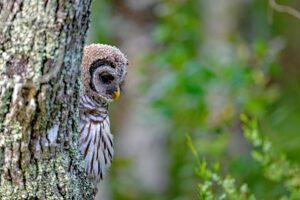
Barred owl by Charles Riegel, NCWF Photo Contest Submission
Barred owls are a common woodland species throughout much of the eastern United States. Despite their large size, they can be surprisingly difficult to spot while resting during the day because of their natural camouflage.
Barred owls have brown and white plumage marked with vertical streaks on the belly and horizontal bars across the chest and wings. These patterns resemble the textures and shadows of tree bark and branches.
Camouflage Strategies
- Background matching (crypsis)
The brown and gray tones of a barred owl’s feathers closely resemble tree bark. When perched against a trunk, the owl can blend remarkably well with its surroundings. - Disruptive coloration
The mix of streaks and bars breaks up the owl’s body outline, making it harder to distinguish among branches and bark patterns. - Behavioral camouflage
Barred owls often sit motionless while roosting during the day. Remaining still allows their feather patterns to blend into the surrounding forest.
Barred owls are often easier to hear than to see. They are often called “eight-hooters”, due to their recognizable series of eight hoots often described as “Who cooks for you? Who cooks for you all?” By following the sound and carefully scanning tree trunks and branches, you may eventually spot one quietly perched and blending into the forest.
Written by:

– Bates Whitaker, NCWF Creative Content Manager

– Dr. Liz Rutledge, NCWF VP of Wildlife Resources