


Tracks, Trails & Telltales: How to Read Wildlife Stories
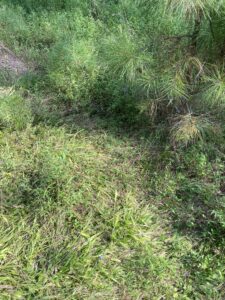
Sometimes wildlife signs are not as obvious as footprints – like this deer bed.
From the backcountry, to suburban backyards, to the small flower beds of busy city streets – wildlife is everywhere. While some habitats are healthier or more hospitable than others, you’d be hard-pressed to find any outdoor space completely devoid of life. Songbirds, insects, squirrels, and countless other creatures quietly weave themselves into even the most developed landscapes.
Yet wildlife can be elusive. Their movements are influenced by weather, food availability, seasonal cycles, and pressures from predators and people. So even though we may not see them directly, animals leave behind “calling cards” – subtle signs revealing their presence. Footprints, trails pressed into leaf litter, scat, nibbled twigs, feathers, fur, and the remnants of meals all tell stories of where wildlife has been and what they were doing.
Learning how to notice and interpret these signs provides rich insight into the natural world. But how can you start? And why take the time to look for them at all?
We’ll cover the who’s, what’s, when’s, where’s, and why’s behind searching for wildlife signs. We’ll also provide a few ideas on how to elevate your tracking game, information on wildlife species and the signs they leave behind, some ethics and safety considerations, and ways you can use these practices to learn more about the wildlife in your area… and even how it can benefit your conservation efforts!
Why Track & Notice Wildlife Signs
Understanding the Landscape
Whether you’re exploring your own backyard or wandering through a public park, wildlife signs offer a window into the species that call that area home. This information is especially useful for conservation efforts. Knowing what creatures use a landscape – especially elusive ones – helps you make thoughtful decisions about habitat improvements.
For example, spotting rabbit scat near your garden might inspire you to build a brush pile that provides shelter from predators and weather, a safe place to raise young.
With continued improvements for wildlife, you may notice more tracks appearing over time – a sign that your efforts just might be working.
Learn More About Wildlife
Books, videos, and expert advice are great, but nothing compares to learning directly from wildlife. Observing how animals move through a landscape turns the outdoors into a living classroom and deepens your understanding far beyond what you can glean from a screen or page. However, for those with mobility or time limitations, there are many on-line wildlife cameras that can immerse you into nature without disturbing the animals you’re viewing.
A Resource for Youth Education
Tracking and exploring for wildlife signs is an engaging, hands-on way to connect children with nature. It encourages curiosity, problem-solving, and observation – skills best cultivated outdoors where kids can interact directly with nature.
Lastly… It’s Fun
Exploring the outdoors by slowing down and noticing the quiet details of wildlife is an enjoyable activity for all ages. It’s a powerful way to sharpen observation skills and connect with the natural world.
Who’s Leaving Tracks?
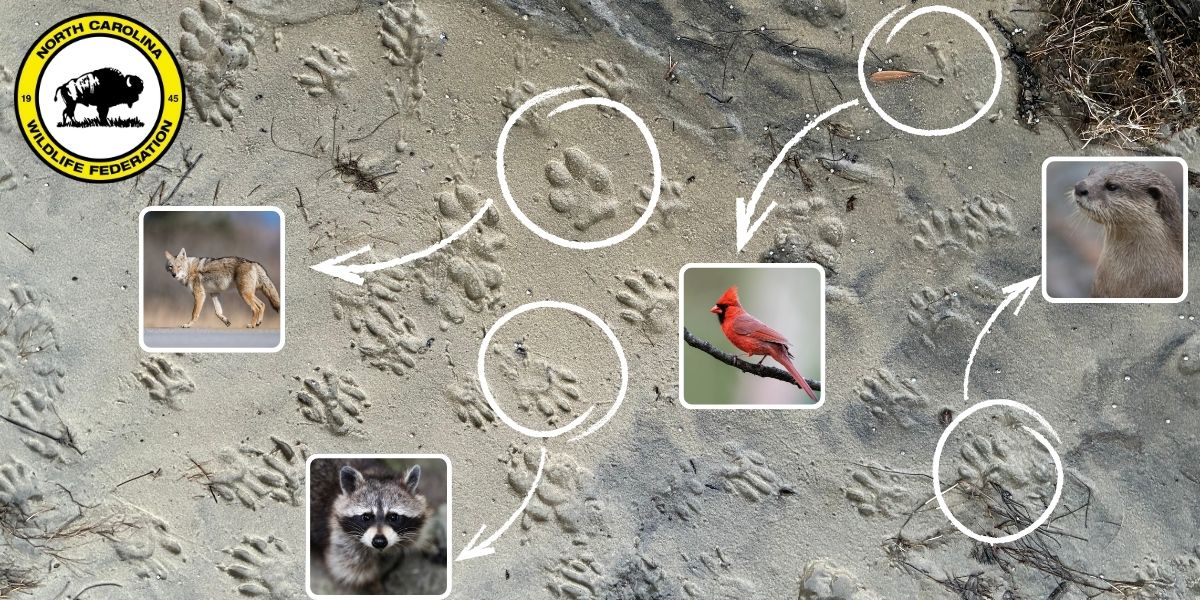
Regardless of the species, all wildlife leave signs of some kind – though some might be harder to notice than others. Wildlife that interacts with the ground are often easier to notice, as they leave scat, footprints, and other signs that are easier to see and identify after the animal has gone, than birds who may rarely make contact with the ground.
But there are some common species that leave signs that are easier to notice if you pay close attention. Here’s a few to look out for in your area.
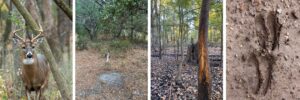
White-Tailed Deer
Tracks:
Heart-shaped prints, 2–3 inches in length. The tips of the hooves point sharply forward, and deer that are running often show a wider distance between the hooves.
Other Signs:
Distinct trails through woods or vegetation, oval-shaped scat pellets (similar in appareance to chocolate raisinets), bark rubbing from bucks, a section of exposed dirt from buck “scrapes”, and bedding depressions in grass or leaf litter. Other signs may indicate the impact of deer browsing, such as multiple broken off twigs, small branches, or sprouts/saplings.
Considerations:
Look for deer tracks near water sources, along trails, forest edges, and around food sources. Many times deer will often follow the same packed-down paths repeatedly.

Raccoons
Tracks:
Highly distinctive “human hand-like” front prints with long fingers. Rear tracks resemble elongated human footprints, often 2–3 inches in length.
Other Signs:
Disturbed grass from foraging, leftover food scraps, and scat placed on logs, rocks, or near water.
Considerations:
Raccoons often travel along creeks and culverts so their tracks frequently appear in mud or sand.

Squirrels
Tracks:
Front paw prints are small with four toes; hind paws show five toes and may overlap front tracks in a bounding pattern.
Other Signs:
Chewed nuts or bare pinecones, bark stripping, small holes where food was cached, and nests (dreys) in tree forks.
Considerations:
Look for small, bounding track patterns that resemble pairs of dots leading toward trees.
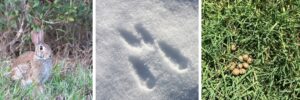
Cottontail Rabbits
Tracks:
Rear feet land ahead of the front feet in a “Y” or “T” formation with the rear prints longer than the front and often side-by-side.
Other Signs:
Small, round scat pellets; clipped vegetation cut at a 45-degree angle; fur caught on low branches or fences.
Considerations:
Rabbits prefer brushy cover and tracks often appear at dawn or dusk when they’re most active.

Opossums
Tracks:
Opposum prints almost look “prehistoric”—the rear foot has a thumb-like toe pointing inward and tracks often appear splayed or messy.
Other Signs:
Scavenged carcasses and look for den sites beneath sheds, logs, or in tree cavities, among other places.
Considerations:
Their slow, ambling gait leaves a wandering or zig-zag track pattern.
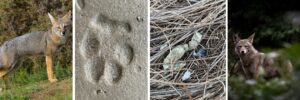
Coyotes and Foxes
Tracks:
Often confused with domestic dogs, coyote tracks are oval and symmetrical with tight toe grouping while fox tracks are smaller and narrower with dainty, precise steps – referred to as a “direct register” track.
Other Signs:
Scat containing fur or seeds, small prey remains, and these species will utilize trails traveled by other species like deer.
Considerations:
Foxes often place tracks in a straight line whereas coyotes show a slightly wider gait.
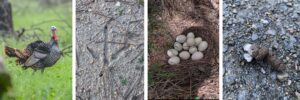
Wild Turkeys
Tracks:
Three long forward-pointing toes and one small rear toe; prints are 4–5 inches in length.
Other Signs:
Bowl-shaped indentations and areas void of vegetation on the ground where they take dust baths, large curlicue or j-shaped bird droppings, feathers, and scratch marks on the ground from foraging for insects. Turkeys also create large nests on the ground with multiple eggs, which will help you identify that a female turkey is in the area; however, if you come across a nest, keep your distance and don’t touch or disturb the nest or eggs.
Considerations:
Tracks are commonly found on creek banks or in swamps, along field edges, and on dirt roads.

Owls
Tracks:
Owls rarely leave ground tracks, but when they do, they show three forward toes and one back toe, often close together.
Other Signs:
Pellets containing bones and fur, feathers, and landing marks in snow.
Considerations:
Look for signs beneath potential roost trees or near meadow edges where they hunt, and listen for their distinct calls, usually at night.

Songbirds
Tracks:
Tiny, delicate three-toe-forward and one-toe-back prints, often in clusters around food sources.
Other Signs:
Dropped seeds, feathers, small scratches, and trails beneath bird feeders.
Considerations:
Patterns can reveal behavior—scratching indicates foraging; long single-file marks may indicate escape or flight.

Insects and Earthworms
Insects
Tracks:
Very small, repetitive dots or tiny parallel lines, mostly seen in damp soil or mud. Some insects drag parts of their body, leaving wavy lines behind them.
Other Signs:
Chewed leaves, bore holes in wood, frass (fine sawdust-like droppings), and tunnels on plant stems. Occupied or empty cocoon or larval shell casings are another indicator of insect presence – just remember to leave them alone if they appear occupied!
Considerations:
Look for patterns rather than individual prints – often the “story” is in the damage or disturbance they leave behind.
Earthworms
Tracks:
After rain or in moist soil, worms leave winding surface trails and small castings (piles of processed soil).
Other Signs:
Soil plugs, tiny openings in the ground, and raised ridges in grassy areas from tunneling.
Considerations:
Trails are easiest to see early morning after heavy dew or rainfall.

Snails and Slugs
Tracks:
Shiny, glistening slime trails zig-zagging across rocks, logs, or leaves.
Other Signs:
Holes chewed in vegetation, often with smooth edges, and empty shells from dead snails near damp areas.
Considerations:
Look for trails in shaded, moist environments – especially after rain or during humid evenings.
When and Where to Look for Tracks
Best Times
Wildlife signs can appear at any time, but certain conditions make them far easier to spot. Early mornings after rain or frost create soft soil and crisp surfaces that capture even delicate impressions. A light dusting of snow can also transform the landscape into a brightly lit storybook of tracks.
Because many species – including deer, raccoons, and opossums – are most active at twilight or night, early morning and just after dark are prime times to look for fresh tracks.
Best Places
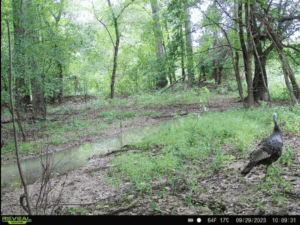
 The best places to search are often where you’ve already observed wildlife, but there are dependable “hot spots” even without direct sightings. Remember: in order to survive and thrive, wildlife needs food, water, shelter, and places to raise young. Any location providing one or more of these is worth taking a closer look.
- Muddy or wet areas – riverbanks, field edges, drainage ditches, and even temporary puddles – capture clear tracks and may serve as travel corridors and/or water sources.
- Under trees, shrubs, and natural cover, you may find sheltering signs from rabbits, ground-nesting birds, or small mammals. Even perching birds drop feathers and scat, and leave subtle marks.
- Transitional areas – where fields meet woods or where cover types change – are prime wildlife ‘highways’ and that may provide an abundance of food sources for many species.
- Food sources like fruiting shrubs, pollinator patches, or even backyard bird feeders often collect feathers, tracks, or feeding signs. Additionally, you’ll often find the tracks of predator species following other animals.
How to Track: Field Techniques
There’s no perfect formula for tracking, but being intentional increases what you’ll notice. As you explore, keep this list in mind:
- Move slowly and scan widely. Get a sense of the whole landscape before focusing on finer details.
- Think like an animal. Consider where wildlife might find essential resources or how they might move between them. Even if food or cover isn’t present, the area might still function as a travel corridor. You may even have to get a little lower to the ground to view the landscape from an animal’s point of view to notice certain trails, details, or features.
- Locate trails and corridors. Animals almost always move with a purpose and prefer paths of least resistance. Watch for natural funnels like creek bottoms or human-made disturbances that might redirect their routes.
Reading the Story: Interpretation Basics
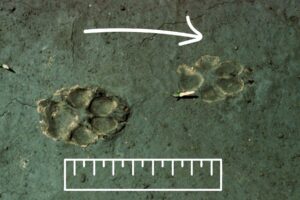
When interpreting wildlife sign, its useful to take measurements. With tracks, its good to measure the size of the track, the distance between steps, and the direction of movement.
Spotting wildlife signs are the beginning – interpreting them is where the story unfolds. Think of each track, feather, or disturbance as a page in the animal’s book. What happened here? Where was the animal going? What was it doing?
Here are some cues to help piece together the bigger picture:
- Print size: Larger prints may indicate a mature animal; very small prints could belong to a juvenile traveling with an adult.
- Direction: Note where the toes or track patterns are pointing and what terrain features lie in that direction. Were they heading for cover? Food? Water? Escaping a predator?
- Speed: Deep or widely spaced tracks often signal fast movement – possibly chasing prey, escaping danger, or hurrying toward a resource.
- Behavior: Look for nearby clues: chewed plants, disturbed leaves, bedding areas, or clusters of feathers or fur indicating feeding or predation.
As you begin to notice these patterns of behavior, you can piece together a narrative about what the animal was doing or where it was heading. This can be a useful exercise, but remember to account for human bias. Even when the signs seem to point toward a particular conclusion, our interpretation may not reflect the animal’s actual intention or experience.
What Now? What to Do With What You Find
Depending on your intentions, sometimes simply pausing to observe tracks or other wildlife signs is enough. But if you want to deepen your connection with the landscape – or build your skills as a naturalist – there are many ways to take the experience a step further.
Here are some ways to chronicle your discoveries, build your identification skills, and create a record of your wildlife tracking journey:
- Take photographs from multiple angles.
Capture close-ups of the track, a wider shot of its surroundings, and any accompanying clues such as scat, feathers, or feeding signs. These photos become an excellent reference for later identification. - Make track casts with plaster or clay.
While this is a more intensive activity, casting tracks preserves the prints long after weather erases them. Over time, you can build a physical library of prints from different species and seasons. Just remember to clean up after yourself, meaning nothing is left behind in nature - Keep a collection of sketches, prints, or notes.
Sketching tracks helps train your eye, and journaling encourages you to think about patterns, behavior, and habitat. Even simple notes including the date, weather, and species can reveal seasonal rhythms or patterns. - Use community science tools like iNaturalist.
Uploading your observations helps scientists track species distributions, monitor populations, and understand wildlife behavior. Your findings – no matter how small – can contribute to real research. - Share your discoveries.
Whether it’s with friends, children, a local nature club, or on social media, sharing may help build excitement around wildlife and inspire others to take a closer look and become more involved in wildlife conservation.
Safety and Ethics
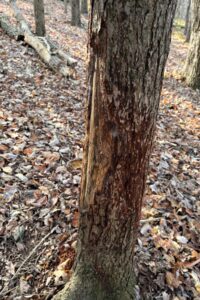
Deer aren’t the only ones to leave marks on trees. Some predators like bobcats and bears use tree trunks as scratching posts. Exercise caution when you recognize potential bear sign.
Tracking is a powerful way to learn about wildlife, but it also comes with responsibilities. Ethical tracking ensures that your presence has minimal impact on the animals and habitats you’re exploring. Staying mindful of your surroundings keeps both you and wildlife safe.
- Observe from a distance; don’t disturb resting animals.
If an animal is bedded down, feeding, or showing signs of stress, give it plenty of space. Disturbing an animal can cause unnecessary stress, and in some cases can cause real danger to the animal or to yourself. - Avoid approaching fresh predator tracks.
Tracks from large predators like bears may indicate they may still be nearby. Respect their space and avoid trailing too closely, especially if you’re uncertain of the species, their behavior, or territory. - Stay on durable surfaces to protect fragile vegetation.
While you’re tracking, plants can be vulnerable to trampling. Use established paths or firm ground when possible, and be mindful of sensitive habitats like wetlands or meadows. - Leave natural items where you found them.
Feathers, bones, egg shells, and nests are all part of the habitat. Under the Migratory Bird Treaty Act, it is illegal to collect the feathers of most native birds, even feathers found individually on the ground. While photographing and observing wildlife from a distance that does not induce stress for the animal and is safe for the observer is encouraged, removing items or disturbing structures can affect animals that may still rely on them so be mindful of your behavior while in nature.
Trail Cameras
Another great way to keep your wildlife observation skills sharp is to use a trail camera, often called a game camera. These battery-powered, weatherproof cameras strap easily to trees, posts, or other sturdy surfaces and are triggered automatically by 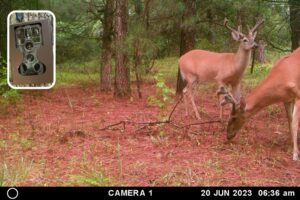 motion. Though they are often used by hunters, many nonhunters use cameras to safely observe wildlife, and they’re even used for real scientific studies, particularly in remote settings. Once set up, they quietly document whatever passes by.
Trail cameras offer several benefits:
- 24/7 Wildlife Monitoring: They capture photos or videos day and night, including species that are nocturnal or too shy to spot in person and can send this pictures directly to your cell phone, if desired.
- Noninvasive & Low Disturbance: Most wildlife barely notices them, making trail cams an ethical way to observe natural behaviors. However, curious animals may intentionally approach or check out your camera because it’s new to them and their surroundings.
- Great for Learning Patterns: You can discover when animals travel, which direction they come from, and which species share the same trails.
- Perfect for All Ages: Checking a camera’s memory card or having the pictures sent to a phone or computer becomes a fun family activity and a natural extension of winter “wildlife detective” work.
- Ideal for Land Stewards: Landowners can better understand what animals use their property – deer, turkeys, foxes, owls, and more – without needing to be outside at the right moment.
Set one up along an animal trail, near a water source, next to a brushy edge, or overlooking your backyard. Combined with on the ground track and sign identification, trail cameras help paint a fuller picture of the wildlife stories unfolding around you.
Written by:

– Bates Whitaker, NCWF Creative Content Manager

– Dr. Liz Rutledge, NCWF VP of Wildlife Resources