
Digging Deeper for Pollinators: NCWF’s Butterfly Highway Seed Trials
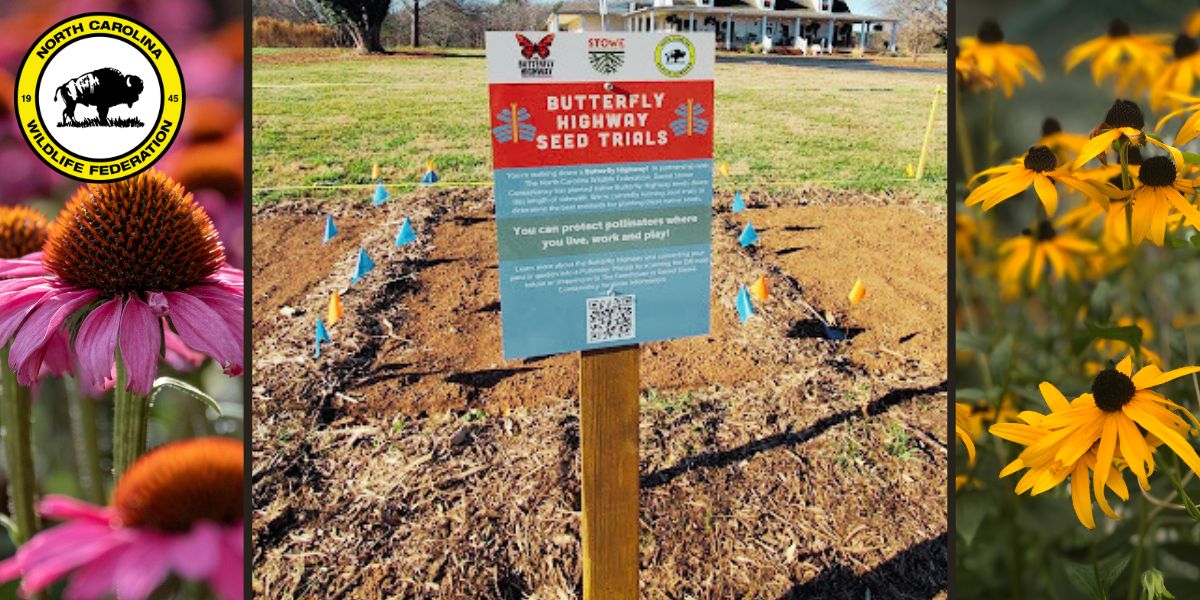
Creating habitat for pollinators is about more than scattering seeds – it’s about understanding what works, where it works, when it works, and why. As interest in pollinator conservation continues to grow across North Carolina, NCWF is committed to ensuring that the Butterfly Highway provides the most effective, accessible tools possible for people eager to make a difference.
To that end, on November 14th, NCWF kicked off its first-ever Butterfly Highway Seed Trials in partnership with Daniel Stowe Conservancy. After surveying Butterfly Highway subscribers earlier in the year, we received an overwhelming response! Now more than ever, folks want to get their hands dirty and participate in pollinator conservation, and NCWF’s Butterfly Highway is an excellent starting point.
Through these seed trials, we are working with horticulturists at Daniel Stowe Conservancy to assess the performance of our Butterfly Highway seed mix over several growing seasons.
When is the best time to sow your seeds? Which seeds perform well in full sun? How about part-shade? When can you expect seeds to germinate? How about bloom? How should I best prepare my site for planting? Our efficacy study will explore all these questions and more!
To kick things off, a handful of staff and community volunteers gathered to prepare and install 6 initial seed plots, which will transform a newly installed sidewalk area at Daniel Stowe into a vibrant Pollinato Pitstop filled with native plants. The existing vegetation (mostly lawn) was scraped off and removed using shovels and human power. Volunteers dug out a well-defined edge to prevent grass from encroaching and scraped the soil loose using gardening forks. Loosening the soil improves seed contact without tilling. Tilling damages soil structure and creates conditions for dormant weed seeds to germinate and grow rapidly.
Three plots were sown with native Butterfly Highway seeds in part shade, and three plots were sown in full sun following our current planting instructions. All plots were lightly watered in. Sowing seeds in November allows ample time for adequate exposure to cold conditions. The majority of native wildflowers require cold stratification, exposure to a period of cold, moist conditions, required to break seed dormancy.
Cold stratification is a survival mechanism that prevents seeds from germinating prematurely. When asters, milkweeds, and coneflowers drop their seeds in late summer or fall, the tender seedlings would be exposed to deadly cold if germination weren’t delayed. Nature has programmed native seeds to await a period of cold before they sprout, timing their emergence with warmer weather and spring.
Scatter your seeds too early, though, and risk loss from predation, wind, weathering, or mold and disease. By seeding plots in November, we can compare germination success with plots seeded later in the winter (February) and see which is more effective.
Since seeding our initial plots on November 14th, we have made the following observations, taken 46 days after planting, on December 30th.
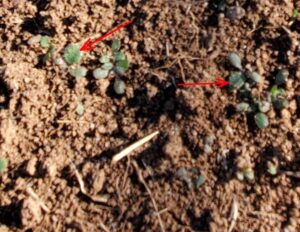
- Black-eyed Susans (Rudbeckia hirta) have begun to sprout. Notice the hairy leaf in the picture below. These are biennial plants and will likely flower this summer.
- Several cool-season weeds have germinated, including white clover (Trifolum repens) and what appears to be henbit (Lamium amplexicaule). Even without tilling the soil, you still have to monitor for weeds.
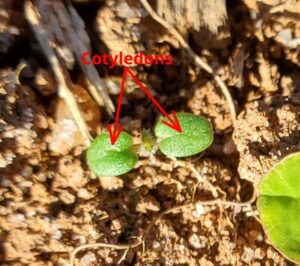
- Several other seedlings have popped up in each plot. However, until the plant grows its first true leaves, identification can

Cool season weeds
be challenging. The initial leaves, called cotyledons, are also known as seed leaves. They do not have the same function or appearance as the true leaves. True leaves have the same appearance and function as all future leaves on the plant.
- Grass that was not completely scraped off and removed has quickly started to grow back. When removing sod and existing vegetation, be sure to get the entire plant, roots and all.
In February, we will prepare and seed six additional plots using the same methods we did in November. We will work with Daniel Stowe to compare the performances of each plot throughout the growing season, documenting the entire process along the way. Down the road, we hope to test different site preparation techniques, seed species, and soil/site conditions.
Stay tuned and sign up for the Butterfly Highway newsletter to receive Butterfly Highway Seed Trial updates as the project moves forward!
Written by:
– Alden Picard, VP of Community Engagement