
In Search of the Frosted Elfin: NCWF Volunteers Survey Rare Butterflies in Northeastern North Carolina
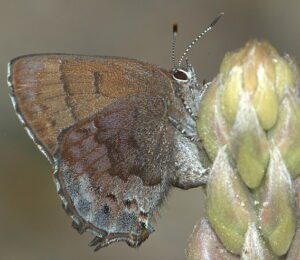
Frosted elfin by Scott Hartley
For a few short weeks each spring, one of North Carolina’s rarest butterflies quietly appears on the Coastal Plain. Small, fast-flying, and easy to miss, the frosted elfin is a challenge to spot – and this spring, volunteers with North Carolina Wildlife Federation set out to help track it down.
NCWF Wildlife Habitat Stewards of Northeastern NC Chapter partnered with biologists from the North Carolina Wildlife Resources Commission to conduct a series of frosted elfin surveys in Gates County at Chowan Swamp Game Land. The surveys are part of an ongoing community science effort to better understand where frosted elfins still occur in North Carolina and how their populations are changing over time.
Frosted elfins are considered a Species of Greatest Conservation Need in North Carolina due to population declines across much of their range. Because the butterfly’s flight season is so short – only a few weeks in mid to late April – every observation can provide valuable information for conservation biologists working to protect the species.
The butterfly itself is modest in appearance compared to some of the larger pollinators like swallowtails and showier pollinators found in spring forests. Frosted elfins are small brown hairstreak butterflies with pale silver scaling along the edges of their hindwings, giving them their “frosted” look. They rely heavily on a select few native plants in the legume family, specifically sundial lupine (Lupinus perennis) and Eastern wild indigo (Baptisia tinctoria) in northeastern NC, which serve as host plants for their caterpillars.
In North Carolina, frosted elfins are most often associated with fire-maintained longleaf pine habitats and open sandy areas where their host plants can thrive. Without periodic fire or other forms of habitat management, many of these open landscapes gradually become overgrown, reducing the conditions the butterflies need to survive.
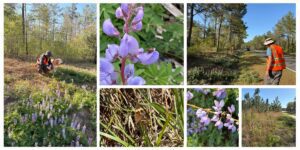
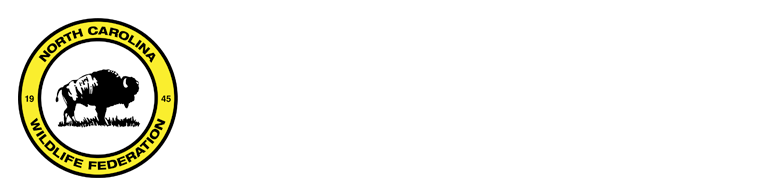
April 21, Frosted Elfin Survey: NCWF Wildlife Habitat Stewards of Northeastern NC Chapter continue their series of frosted elfin butterfly surveys.
Surveys began on April 14 at Chowan Swamp Game Land, where volunteers searched roadside and forest patches of sundial lupine for frosted elfins. Although the butterflies remained elusive throughout the survey series, volunteers documented a variety of other pollinators and spring butterflies, including red-banded hairstreaks, tiger swallowtails, zebra swallowtails, common buckeyes, blueberry digger bees, and Southern Plains bumble bees. Volunteers also monitored patches of Eastern wild indigo, another important frosted elfin host plant, which appeared slightly behind its typical bloom schedule this season.
Additionally, the chapter conducted a night survey in search of bioluminescent frosted elfin caterpillars in mid May. With adult frosted elfins having such a short flight window, nighttime larval surveys are a great tool to extend monitoring efforts. Black lights in hand, volunteers scanned the tops of the sundial lupine flowers, where the caterpillars are most often observed feeding, with hopes of seeing a glowing caterpillar on their host plant. No frosted elfin caterpillars were spotted, but volunteers enjoyed the evening sounds of birdsong from species like Chuck-will’s-widow, North America’s largest nightjar, that breeds in North Carolina’s coastal and piedmont oak and pine woodlands.
Unfortunately, the recent surveys concluded with no sightings. But encouragingly, several independent community scientists later reported frosted elfin sightings from within the survey area to North Carolina Wildlife Resources Commission biologists.
Those reports highlight exactly why community science efforts matter. Because frosted elfins occur in scattered populations and are active for such a short time each year, it takes many people spending time in the field to build a clearer picture of where the species persists.
NCWF hopes these surveys not only contribute valuable data, but also help people connect with North Carolina’s diverse ecosystems and the many species that depend on them. Sometimes conservation work means celebrating a rare sighting – but other times, it simply means showing up, paying attention, and continuing the search.
Written by:
– Laura Neitzey, Refuge Conservation Coordinator

– Bates Whitaker, NCWF Creative Content Manager