


Wildlife Architects: Nests, Burrows, and Other Ingenious Animal Homes
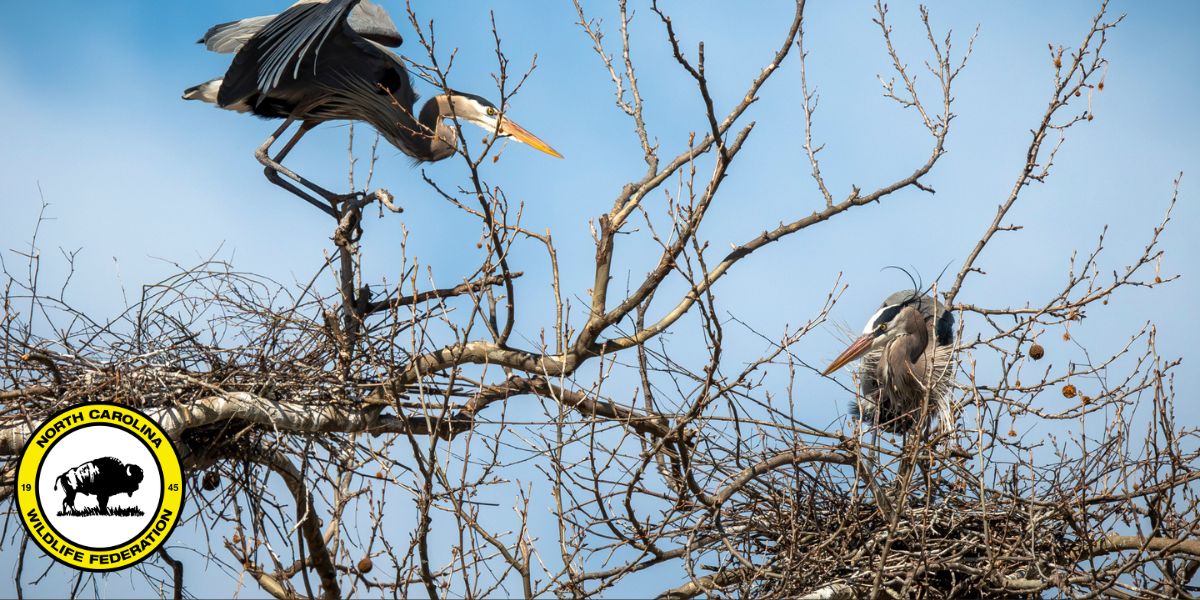
One of the most noticeable impacts that humans have had on the landscape is right in front of our eyes, nearly everywhere we turn – our architecture. The homes, buildings, and infrastructure that we build have evolved over centuries to suit our needs and adapt to current circumstances.
Without a doubt, humans are impressive builders and, though there are negative impacts to wildlife habitat and natural landscapes as a result of our development, our architecture is something to be admired.
But we are far from the only species to exercise architectural practices and processes – and ours are often no more complex than those of other species.
A vast range of wildlife species build homes out of natural materials to suit their needs in environments they have adapted to. We will explore some of the many wildlife architects, how they build their structures, why they build them, and how an understanding of wildlife architects can contribute to protecting, conserving, and restoring these species and their habitats.
Why Does Wildlife Build?
Osprey nest by Steve Gorin, NCWF Photo Contest Submission
For wildlife, survival is a full-time job. The drive to build homes can be explained through the core necessities that wildlife need to survive and thrive: food, water, shelter, and places to raise young.
Shelters of various kinds, whether a nest in the treetops or a burrow underground, provide protection from predators, a buffer from the elements, a place to raise and protect offspring, and, in some cases, food access and storage.
For some species, these places also provide a hub for communication and social organization, such as termite mounds, ant hills, and other insect nests. In these cases, the home provides nurseries, food storage, ventilation, and even waste disposal – all in one place.
Well designed structures also assist with energy efficiency. Building once saves energy later. A well-designed home reduces the need to constantly flee, regulate body temperature, or search for safe resting spots.
How Does Wildlife Build?
Golden silk orb weaver web by Neva Scheve, NCWF Photo Contest Submission
The methods by which wildlife creates structures are complex and vary across species. Wildlife have adapted over time to build homes that best fit their needs, and from materials that are present within their surroundings.
Some species excavate burrows to escape predators, regulate temperature, or store food, while others assemble nests or lodges from sticks, leaves, and other natural materials to create secure, insulated shelters.
Many animals modify existing structures, such as tree hollows or abandoned nests, taking advantage of what’s already available.
Some even engineer with fluids or mud, like mud dauber wasps, whose layered mud nests protect their developing young.
Often, species combine strategies: beavers, for example, assemble branches and vegetation to build dams and lodges, then reinforce them with mud to create a stable, multi-functional structure that controls water levels, provides shelter, and supports their social needs.
Why’s It Important
American beaver by Lynn Carter, NCWF Photo Contest Submission
From a conservation perspective, understanding wildlife architecture is more than just fascinating – it is essential. Knowing where, how, and why species build their homes helps inform smarter conservation and land management decisions.
Homes are foundational for wildlife survival. When we alter natural landscapes, we are not just changing scenery – we are removing the raw materials and safe spaces wildlife depends on.
In the absence of critical natural materials – large trees for nesting, native vegetation for structure, soil for burrowing – some species simply cannot create homes. Without adequate resources, reproduction may decline. Without safe nursery space, young may not survive. And without the ability to build, species that once thrived may quietly disappear from an area.
To see these principles in action, let’s explore a few species whose building strategies shape both their survival and the ecosystems around them.
Exploring Some Wildlife Builders
American Beaver
When thinking about wildlife architects, American beavers (Castor canadensis) are often the first species that comes to mind – and for good reason.
What may appear to a casual observer as a jumbled pile of sticks in a stream is actually a carefully engineered, multi-purpose structure. Beaver dams are complex constructions made from sticks, branches, mud, stones, and vegetation, often reinforced by natural features like fallen trees. Beavers only build dams when necessary, primarily to control and maintain water levels in their habitat for the purpose of food storage and protection from predators. However, in wider rivers, they may forgo dams altogether, instead digging tunnels and burrows deep into riverbanks to avoid flooding and predators.
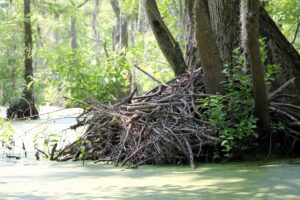
Beaver lodge by Jane Plough
Through dam building, beavers dramatically reshape their surroundings. Their dams slow the flow of water, creating ponds and wetlands that trap sediment and reduce downstream flooding. These ponds can improve water quality by filtering excess nutrients and chemicals and allowing water to slowly percolate into the ground, helping recharge groundwater reserves. Beaver-built canals further expand their architectural footprint, opening access to new feeding areas and enabling the transport of food and building materials. These canals may even be dammed during droughts to retain water.
The environmental impact of beaver engineering extends far beyond the animals themselves. By flooding areas and creating wetlands, beavers generate rich, diverse habitats that benefit countless other species, including ducks, herons, otters, frogs, turtles, and many more. The endangered St. Francis Satyr butterfly, relies directly on fire and beaver-created habitats for survival. Whether through dams, canals, lodges, or burrows, beavers continuously modify land and water in ways that enhance ecosystem complexity and resilience – earning them their reputation as true ecosystem engineers.
Bald Eagle
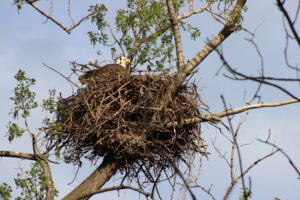
Bald eagle nest by Courtney Celley, USFWS
Bald eagles (Haliaeetus leucocephalus) are master builders whose nests rank among the largest and most enduring structures created by any bird. Nest-building is central to eagle pair bonding and reproductive success, demanding strength, coordination, and repeated cooperation between mates. Eagles typically construct their nests high in large trees or on cliffs, using sticks and branches layered into platforms that are generally five feet wide and four feet deep, and can reach up to 10 feet in diameter. Large nests can weigh thousands of pounds, with the largest bald eagle nest on record weighing 6,000 pounds. The significant sizes of these nests are largely due to the fact that nests are not built once and abandoned; instead, they are repaired, expanded, and reused year after year, creating visible “rings” of construction that record generations of use.
Nest design is shaped by experience, instinct, and the physical constraints of the site – tree species, branch arrangement, height, and exposure to wind all influence the final form of the nest. Researchers have identified a range of nest shapes, from bowls and disks to cones and cylindrical stacks, depending on how the nest is supported. While young eagles observe nest-building during their early lives, they do not actively participate, and nest construction appears to rely more on imprinting and environmental opportunity than on learned traditions.
Pileated Woodpecker
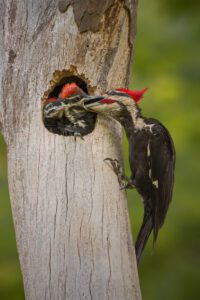
Pileated woodpecker cavity by Griffin Nagle, NCWF Photo Contest Submission
Using dead or decaying trees, pileated woodpeckers (Dryocopus pileatus) excavate deep, rectangular cavities that serve as nesting and roosting sites. The excavation process can take several weeks to months and requires remarkable precision. The birds use their strong, chisel-like bills to remove wood, creating cavities that can be 10 to 24 inches deep, depending on the tree and the size of the bird. Excavation is a deliberate process: the woodpecker targets sections of decaying trees that are soft enough to carve, yet sturdy enough to maintain a cavity for several years. Once constructed, they line the inside of the cavity solely with wood chips produced through excavation.
Despite the time and effort invested in excavation, pileated woodpeckers rarely reuse nesting sites in subsequent years. However, the cavities do not go to waste. What begins as a single pair’s home often becomes a long-lasting structural feature of the forest. While the birds often leave the cavity after the nesting season, the hole remains and is quickly claimed by other species that cannot excavate their own cavities. Secondary cavity users such as wood ducks, barred owls, screech owls, kestrels, bats, flying squirrels, raccoons, and even some reptiles depend on these ready-made homes. Many of these species require large, spacious cavities that only pileated woodpeckers are capable of creating, making the birds a keystone species in many forest ecosystems.
Brown-headed Nuthatch
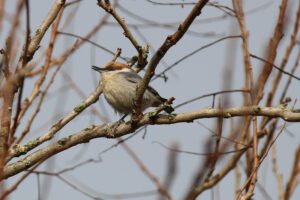
Brown-headed nuthatch by Warren Bielenberg, Great Smoky Mountains National Park
Unlike woodpeckers, brown-headed nuthatches (Sitta pusilla) are not powerful excavators – but they are skilled renovators. While they are capable of forming their own cavities in particularly soft or decaying wood, they largely rely on existing cavities in dead or decaying trees, often modifying old woodpecker holes by cleaning them out and lining the interior with bark, pine needles, grasses, or feathers. These careful alterations turn rough cavities into well-insulated, functional homes suited to their small size.
Nuthatches are also great at problem-solving and are the only known North American birds to habitually use tools. They use small twigs and pieces of bark to pry loose wood flakes while enlarging or refining a cavity and foraging for food.
Bald Faced Hornet
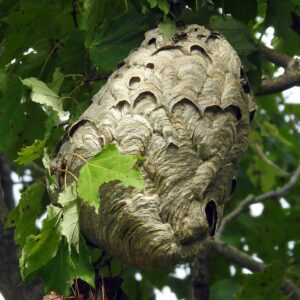
Bald faced hornet nest by USFWS
Bald‑faced hornets (Dolichovespula maculata) are often recognized by their large, football‑shaped paper nests hanging from tree branches or structures. They are master builders of paper‑like combs, using wood fibers they gather from weathered posts, logs, and branches, which they mix with saliva to create a sturdy, layered envelope that protects their colony.
Nests can reach the size of a basketball or larger and are constructed in a surprisingly short amount of time. A single overwintering queen hornet begins building a nest by herself to lay the first of her brood. As the first cycle of brood emerges, they begin assisting her in building the nest. As more broods emerge and mature individuals join the workforce, the colony adds onto the nest and increases its size.
This effort requires coordinated work by many individuals to weave and layer material into a thermally buffered shelter for brood development. The process typically begins in early April or May as the queen emerges from winter diapause, and the process of nest building continues into late summer or early fall when the nest achieves peak size and brood productivity. During winter, nests are abandoned and new nests are created the following season.
The intricate structure of a bald‑faced hornet nest reflects both engineering skill and adaptive design. The layered paper walls help regulate internal temperature and humidity while providing defense against rain and wind; the multiple combs inside are organized for efficient brood care. Because the nests are conspicuous and durable throughout the active season, they become a notable feature of the local physical landscape in forests, fields, and suburban woodlands, even after the colony has left.
Oldfield Deermouse
The oldfield deermouse (Peromyscus polionotus), native to North Carolina’s open woodlands, fields, and sandy soils, is a small mammal with a talent for efficient, purposeful architecture. Unlike species that rely heavily on existing shelters, oldfield mice excavate their own burrow systems, creating networks of tunnels and chambers just below the surface. These burrows typically include a nest chamber lined with grasses or shredded plant material, multiple escape routes, and sometimes a separate storage area for seeds.
Burrow architecture allows oldfield mice to regulate temperature and humidity while remaining concealed from predators. The multiple entrances reduce the risk of ambush, while shallow tunnel depth allows quick access to surface food sources. These burrows are often placed in sandy or well-drained soils, which are easier to excavate and less prone to flooding. While some other burrowing mammals go deeper into the soil, oldfield deermice burrows are short-lived and near the surface. The repeated construction of these shallow burrows across their early successional habitat nonetheless results in extensive soil disturbances and mixing over time in the shallow soil horizon.
Crayfish
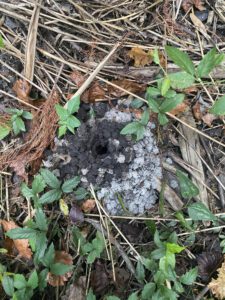
Crayfish burrow by NCWF Southeastern Swamp Stewards Chapter
Several native crayfish species in North Carolina, particularly primary burrowers such as the piedmont blue burrower (Cambarus depressus) and related Cambarus species, are influential but often overlooked wildlife architects. These crayfish construct complex underground burrow systems in wetlands, floodplains, ditches, and stream margins, sometimes far from open water. While some burrows can extend up to fifteen feet deep in muddy soils, most extend about three feet into the soil and often include multiple chambers connected by vertical and horizontal tunnels. The excavated soil is deposited at the surface, forming distinctive chimney-like mounds that mark the hidden architecture below.
Crayfish burrows function as carefully engineered refuges that regulate moisture, temperature, and oxygen levels. Many burrows reach the water table, allowing crayfish to survive droughts and seasonal drying while remaining protected from predators and extreme temperatures. The architecture is not static: crayfish continuously maintain and modify their burrows, reinforcing walls, reopening collapsed passages, and adjusting entrances in response to rainfall and flooding. These subterranean structures can persist for years and are reused across seasons, even as surface conditions change dramatically.
The ecological effects of crayfish burrowing extend well beyond the crayfish themselves. By mixing soil layers and creating channels between surface water and groundwater, crayfish can play a role in increasing soil aeration, influencing hydrology, and facilitating nutrient cycling. However, in areas of high crayfish density (particularly in the instance of invasive crayfish species), the impact to the ecological community and ecosystem processes can suffer. Abandoned crayfish burrows also provide shelter for insects, amphibians, small reptiles, and other invertebrates. In wetlands and riparian systems in particular, crayfish burrows can enhance habitat complexity both above and below ground.
Written by:

– Bates Whitaker, NCWF Creative Content Manager

– Dr. Liz Rutledge, NCWF VP of Wildlife Resources