

Holding Onto Hope: Celebrating NCWF’s 61st Governor’s Conservation Achievement Awards
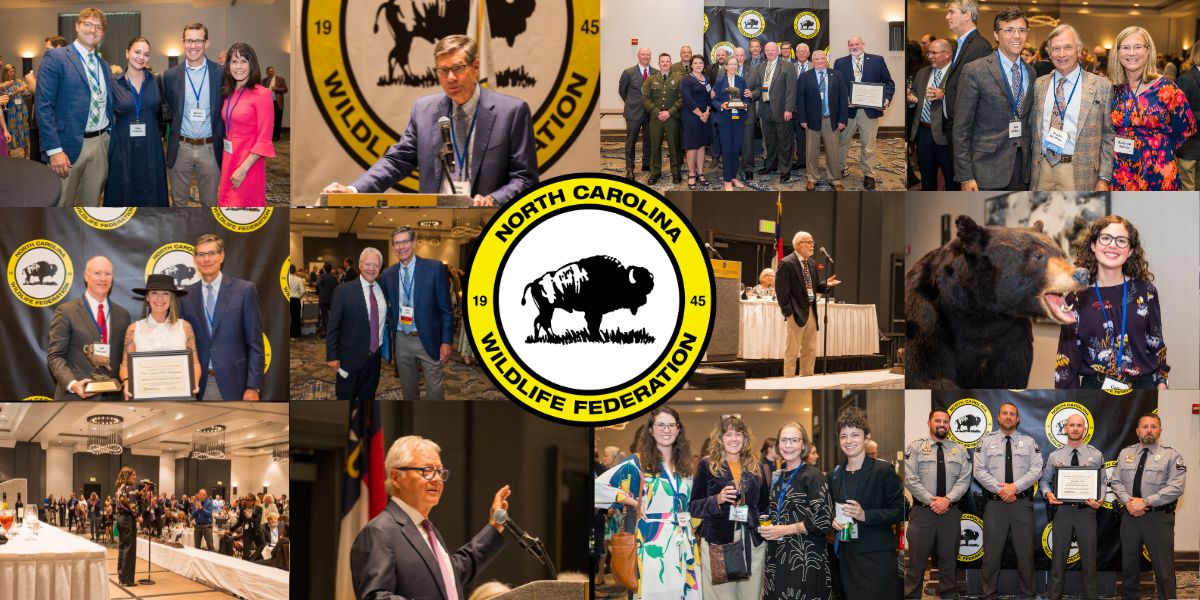
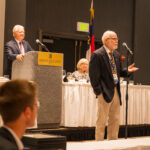
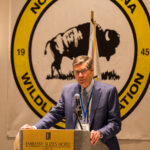
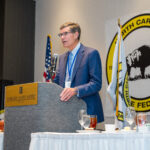
The work of conservation rarely offers easy wins. It asks for patience, resilience, and a willingness to keep going – even when the path forward feels uncertain. In his remarks, banquet emcee and award chair T. Edward Nickens acknowledged that reality, while also pointing to something just as enduring: the people who refuse to sit on the sidelines.
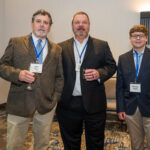
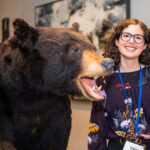
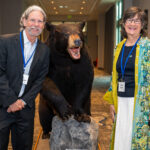
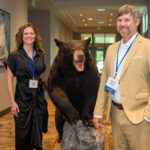
That balance – between challenge and determination – was at the heart of the 61st Annual Governor’s Conservation Achievement Awards. Eighteen outstanding conservationists were recognized for their efforts to protect, study, and restore North Carolina’s wildlife and habitats, each one contributing in ways that ripple far beyond a single project or place.
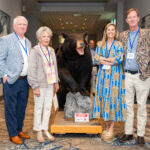
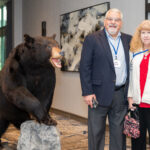
On May 2, 2026, more than 300 attendees gathered for an evening that celebrated not only achievement, but momentum. The stories shared reflected a deep sense of curiosity and commitment – people exploring, learning, and pushing boundaries right here in North Carolina.
Since its founding in 1958, the Governor’s Conservation Achievement Awards program has stood as the state’s highest honor for natural resource stewardship. Each year, it brings together individuals and organizations who remind us that conservation is not a distant ideal, but an ongoing, collective effort.
“Tonight we celebrate people who push the limits, broaden our understanding of this state we love, and remind us that even in difficult times, hope is still in our hands—and we are never standing alone,” said T Edward Nickens. “In one hand, the challenges we face. In the other, the people in this room – proving that hope is alive, action is possible, and none of us stands alone when we stand up for conservation.”
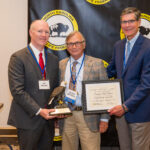
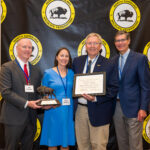
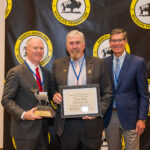
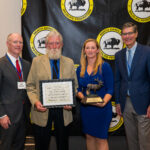
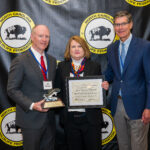
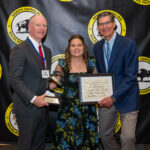
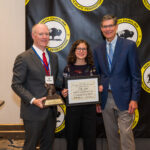
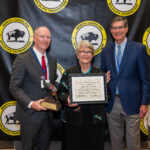
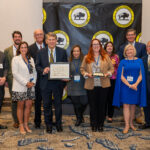
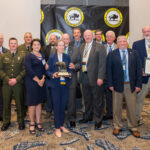
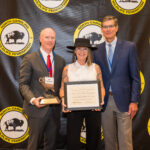
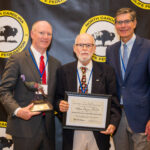
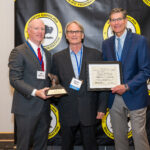
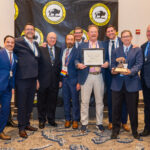
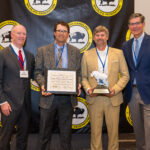
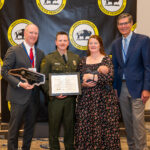
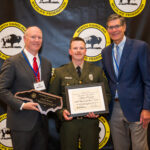
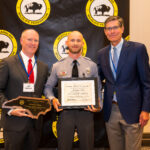
North Carolina Attorney General Jeff Jackson gave an introductory address to open the event, and NCWF Board Chair Dave Cable and Jeff Michael, Deputy Secretary for Natural Resources presented honorees with custom-made wildlife statuettes.
Below we share highlights from T. Edward Nickens’ presentation of the awardees.
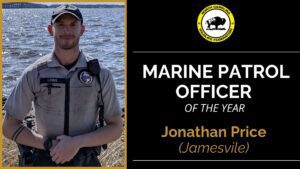
“If you find yourself out on the water and in a bit of trouble – lost, broke down – then Officer Jonathan Price is the man you want to call. He has completed Land Search Field Team Training, ATV Search and Rescue Training, and is a certified member of the NC Marine Patrol Swift Water Rescue Team. During Hurricane Helene, he deployed to western North Carolina, assisting with large-scale evacuations and participating in a life-saving rescue of a woman trapped in rising floodwaters.
He grew up along the Roanoke River, and it’s the kind of place that makes a person want to protect it from harm. And hold others to the same standard. That’s what Price did for six years with the Bertie County sheriff’s office. And that’s what he’s done ever since he joined the North Carolina Marine Patrol.
Officer Jonathan Price is the 2026 Marine Enforcement Officer of the Year.”
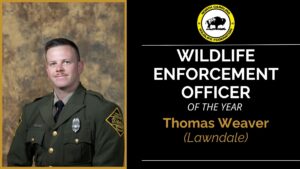
“The waters of Moss Lake, Mountain Island Reservoir, Lake Norman, and Lake Wylie are Officer Thomas Weaver’s wheelhouse. This past year, he apprehended six boaters that were boating while impaired.
He also cited four other drunk boaters who had pulled their boats out of the water and were leaving the boat ramp, no doubt laughing that they’d made it off the water without seeing any flashing lights when all of a sudden, flashing lights appeared. Weaver has a knack for finding trouble on the water and putting an end to it. Sometimes, in a life-saving way.
He helped pull a struggling father and his two-year-old daughter out of Moss Lake and on Mountain Island Reservoir, a young man was thrown out of his johnboat, and wasn’t wearing a kill switch, so the boat motor stayed on, and circled and circled in smaller circles. It’s a deadly situation. Weaver hurled a throw bag with a rope at the victim as his partner manned their patrol boat. The swimmer was pulled to safety right as the unmanned johnboat plowed into the patrol boat. Another life saved.
Senior Officer Thomas Weaver has a thing: On his watch, you’d better bring a six-pack of common sense with you when you’re boating on his water.
He is the Governor’s Wildlife Enforcement Officer of the Year.”
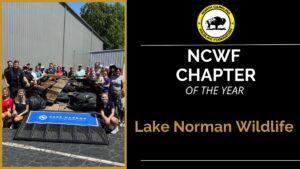
“The headlines about Hurricane Helene relief in North Carolina’s rivers and lakes largely centered on efforts to get stuff out of the water – trees, chunks of bridges, pieces of houses, a million kinds of trash. That was all critical and needed.
But it’s also been heartening to hear of the efforts of groups like Lake Norman Wildlife. While Lake Norman wasn’t as hard hit as areas to the west, the hurricane still sent tons of trash, broken docks, and more into the forests surrounding the lake.
And once Lake Norman Wildlife was finished leading cleanup efforts, it immediately shifted to the task of putting the good stuff back into Lake Norman and the surrounding area. Good stuff like Christmas trees to create fish habitat – the chapter has put 2,000 trees in Lake Norman so far.
They coordinated the installation of a ninth rock reef. For six weeks in the spring, they put young people into the wild through the group’s Young Explorers programs. From hosting Island Adoption days to participating in public events such as Earth Jam and Symphony in the park, Lake Norman Wildlife has never faltered in connecting their community to water and wildlife. It is the NCWF 2026 Chapter of the Year.”
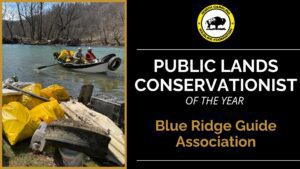
“The guides of the Blue Ridge Guide Association have realized that no one has a bigger stake in keeping trout waters healthy than trout fishing guides. And the guides of western North Carolina, east Tennessee, and southwestern Virginia are a first line of understanding and a first line of defense when it comes to coldwater fisheries.
Formed in 2022, the Blue Ridge Guide Association is doing a very guide-like thing: They aren’t waiting around for someone else to tell him how to take care of their own back yard. In that last year they’re raised the money and the manpower to place water quality monitoring sensors across big rivers and small tributaries.
They’ve kicked off events to raise awareness of issues facing trout conservation. And they’ve found themselves in a bit of a David and Goliath scenario, working with the Tennessee Valley Authority to manage dam releases in the Watauga and South Holston Rivers in ways that support, and do not damage, trout populations in those world-renowned rivers.
Around the country, fishing guides are rising up as powerful new allies in the conservation arena. The Wildlife Federation welcomes them to the table, and we urge the greater conservation community to partner up.
And we can all start with the Blue Ridge Guide Association, the 2026 Governor’s Public Lands Conservationist of the Year.”
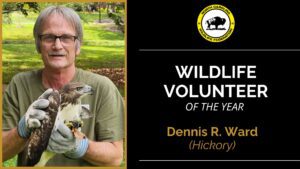
“Dennis Ward is a raptor rescue volunteer with the Carolina Raptor Center, and in 2025 alone, he responded to 177 raptor rescue calls.
He has gone through extensive training to learn how to handle and transport injured raptors. He loves engaging with the public during these rescues, educating bystanders about the role of raptors in ecology, and ways to reduce human-wildlife conflicts.
When asked why he dedicates so much time as a raptor rescue volunteer, Ward once said that “It feels good earning his keep on this planet.” I don’t know that I’ve ever heard a better explanation for giving back to wildlife, for working for habitat, for lending a hand to the wild world around us. Thanks for that insight, Dennis.
I’m thrilled to introduce you as the 2026 Governor’s Wildlife Volunteer of the Year.”
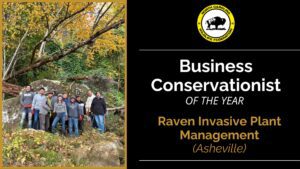
“The traditional approach to removing noxious plants is to carpet-bomb them with even more noxious chemicals. But Raven Sterling thought there had to be another way.
Her Asheville-based company has developed non-chemical methods to remove and suppress invasive species and let native trees, shrubs, and wildflowers flourish. Raven Invasive Plant Management works in the Blue Ridge range of the Appalachians, one of the most biologically diverse places on the planet, and its work takes into account a deep botanical understanding of plant reproduction, seasonality, reseeding, and soil revitalization techniques.
If you think that sounds like something that might cause a lot of shovel blisters, well, you’re right. But Raven Invasive Plant Management work is more enduring than chemical treatments, better for pollinators than chemical treatments, and supports a harm-free approach to letting forests do what they were designed to do: Breathe.
Raven Invasive Plant Management is our Business Conservationist of the Year.”
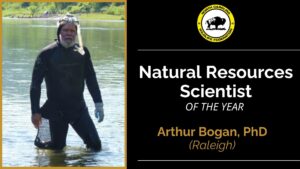
“2026 marks Dr. Art Bogan’s fiftieth year researching the biology, systematics, and conservation of freshwater mussels.
Art Bogan has served as research curator at the North Carolina Museum of Natural Sciences since 1969. He has done field work in twenty countries and described 37 new species and four new subspecies. Seven species, a subspecies, and an entire Genus have been named after him. He has published 233 peer reviewed articles and 14 peer reviewed books. And his publications don’t just sit on shelves and collect dust; they have been cited more than 12,800 times and continue to garner hundreds more citations every year.
Freshwater mussels are a first line of defense in the service of clean water. But unfortunately, these creatures are often the last things on the minds of those who would abuse our creeks and streams and rivers. We are fortunate to have as a fellow North Carolinian someone like Art Bogan, who has dedicated his career to shining a light on some of the critical building blocks of our native, natural environment.
He is the Governor’s Natural Resources Scientist of the Year.”
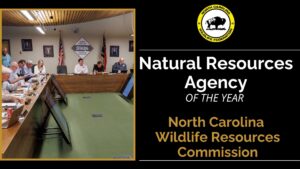
“The road to recovery for the Red Wolf has been as rocky as one could imagine. Beleaguered to the point that wildlife managers in state and federal agencies had recently lost trust in the process, in each other, and in the future of the Red Wolf.
Thankfully, a new era of cooperation between the U.S. Fish and Wildlife Service and the NC Wildlife Resources Commission dawned with the recent signing of a resolution and a Memorandum of Understanding.
The Commission’s resolution and MOU spurred the trajectory of Red Wolf recovery and the future of state and federal cooperation in wildlife management issues in North Carolina.
The last few years have seen a reinvigorated Wildlife Resources Commission engaging in conservation collaboration, across numerous issues. The result can only be a better future for wildlife in North Carolina.
The Wildlife Resources Commission is the 2026 Natural Resources Agency of the Year.”
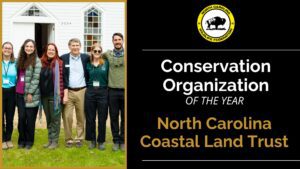
“You have to feel sorry for a lot of North Carolina’s shorebirds, honestly. Terns, black skimmers, oystercatchers, plovers – they all require undisturbed beach for nesting, and I don’t know if you’ve been to the North Carolina coast lately. But undisturbed beach is at a premium. That’s what made the inlet point of Topsail Island so rare and wonderful and special. The 160-acre tract was one of the last privately owned parcels of undeveloped barrier island on the entire coast.
Which made the North Carolina Coastal Land Trust’s herculean efforts to help locals raise $8 million dollars to save The Point so wonderful and special. Slated for development, the Point at Topsail Island could have been condo-fied, neighborhood-arized, and a place that welcomed bazillionaires, and not Caspian terns. But in late November of 2023, the Coastal Land Trust stepped up to negotiate a purchase contract with the owner.
With a local nonprofit called Conserve The point, the land trust launched an ambitious $8 million Save The South End fundraising campaign to secure the purchase and conservation of the property within one year. Nine months later, the community raised $1.6 million in private funds from more than 750 donors and the NCCLT secured $6 million plus in grants. One of the last best wild places along the North Carolina coast was saved. Which was wonderful and special, and all too rare.
So on behalf of terms and black skimmers and plovers everywhere, I’m happy to announce that the North Carolina Coastal Land Trust is the Governor’s 2026 Conservation Organization of the Year.”
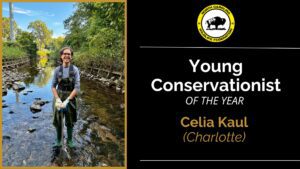
“For six years, Celia Kaul was greeted at her Montessori School in Charlotte by a towering deodar cedar tree. Kids played under the tree. It was the first thing you saw when you got dropped off in the car line. It was a part of every Earth Day celebration at the school. It was a part of her community, Celia insisted.
So when the Charlotte-Mecklenburg school system announced plans to replace the aging school, and cut down the beloved cedar, Celia Kaul sprang into action. With a friend, she made phone calls to arborists in the City of Charlotte, met with the school system and the developers for the bond, did research on whether saving these trees was even possible, wrote essays, started a petition, but most of all, they shared their stories of what that tree meant to them. They were told that it was impossible to stop, that the critical root zone would be too hard to work around, that it would make the developers redo their plans, and sometimes we were met with laughter that a 5th and 6th grader were working against bureaucracies and building contractors.
Celia and her friend never took no for an answer. By the end of the year, after working tirelessly for several months, they had gained an enormous amount of community support, helped run a petition that gained almost 900 signatures, and won the Mayor’s Tree of
the Year award for Charlotte.
And finally, they won. The trees were cordoned off for preservation.
Now, that sounds like a big win, and it was. But the bigger win is what Celia Kaul wrote about the experience. “This may be my first fight,” she said, “but may it never be the last.”
So, get ready, North Carolina. Celia Kaul is the Governor’s Young Conservationist of the Year.”
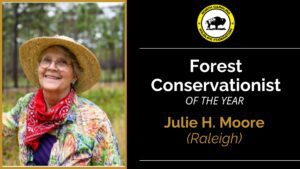
“For forty years, Julie Moore has worked in North Carolina and across the Southeast to bring awareness and understanding and passion to what was an endangered landscape – the vast longleaf pine forests that once covered millions of acres of the American Southeast.
As a biologist with North Carolina’s Natural Heritage Program and then the U.S. Fish and Wildlife Service, she worked on huge public lands properties, from national forests to military installations.
Along the way, Julie Moore showed a particular knack for helping private forest owners maintain and expand longleaf pine on their holdings. She helped put into place programs for private landowners to conserve endangered red-cockaded woodpeckers and gopher tortoises, two species that depend on longleaf pine forests. And in retirement, she still works for the land of the longleaf pine. She is Chair of North Carolina’s Plant Conservation Program Advisory Board and a founding board member of Southern Conservation Partners, a nonprofit organization promoting conservation, restoration, and public awareness for natural heritage resources in the region. And Julie has spent extensive volunteer time and effort advocating for the protection of the Venus Flytrap.
So, for all those reasons, and even more, I’m particularly proud to announce that Julie H. Moore is the Governor’s Forest Conservationist of the Year.”

“Abby Weishenker is the resource education coordinator for the Cabarrus County Soil & Water office. Weinshenker is a mentor, advocate, educator and champion for school kids who want to excel in the incredible array of Cabarrus County environmental education programs. Many of these students are learning English, some are dealing with interruptions in their formal education, and all are striving not only to learn more about the world around them, but about their place in the world around them.
In addition to leading the Envirothon challenges, Weinshanker is available to lead school workshops in more than 50 subjects, from pollinators to wetlands, and bird nests to composting.
Honestly, I was blown away by the breadth of the offerings by the Cabarrus County Soil and Water Conservation District.
If you want a team worth rooting for, a coach you can get behind, let me introduce you to Abby Weinshenker, the Governor’s 2026 Environmental Educator of the Year.”
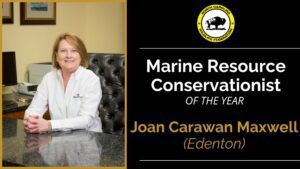
“In 1988, Joan Maxwell and her husband, Owen, started a little boat manufacturing business in an abandoned A&P store in Edenton, NC. Thirty-seven years later, the sleek profile of a Regulator center console boat is recognized, admired, and coveted around the world.
And Maxwell is considered a pioneer in one of the most competitive industries in the outdoor arena. She was the first woman to chair the National Marine Manufacturers Association. She has been honored with the Center for Sportfishing Policy’s Eddie Smith Manufacturer of the Year award.
She and Owen are life members of the Coastal Conservation Association and ardent supporters of smart, sustainable regulation and policy for marines. She’s a local girl from the shores of Lake Mattamuskeet whose horizons have broadened to encompass public trust resource issues and recreational access to our wild places.
These are critical days for marine resources in North Carolina, and the issues impacting our saltwater resources and our beloved saltwater pastimes are complicated and increasingly personal. North Carolina is fortunate to have such a critical thinker, a concerned advocate, and a proven leader such as Joan Maxell in the arena.
She is the Governor’s Marine Resource Conservationist of the Year.”
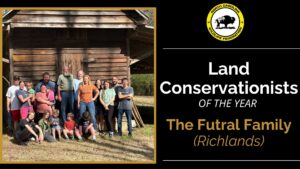
“Last year, the Futrals permanently protected their 465 acres of Onslow County farm and forestland through a perpetual easement held by the Working Lands Trust. The pine uplands and cypress bottomlands will be strictly managed. Longleaf pinewoods will be restored. And Best Management Practices will ensure that the biodiversity of the farm’s wetlands, ponds, and native food plots will maximize their benefit to wildlife.
One of the more intriguing aspects of the deal is that it was put together through a partnership between the Farmland Preservation Division of the North Carolina Department of Agriculture and Consumer Services, and the U.S. Department of the Navy. It’s the first example in Onslow County of an easement that includes the support of training for the Marine Corps based at Camp Lejeune, New River, and Cherry Point. By limiting encroachment and development, the Futrals are supporting the ability of the Navy to train its Marines in wild country.
Which should be something we are all thankful for. The Futral family is the 2026 Land Conservationist of the Year.”
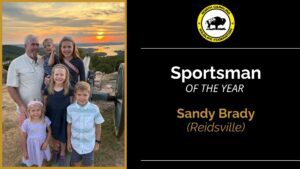
“Sandy Brady has been a hunting guide in South Dakota, and a television host on ESPN.
He created the Traveling Pocket Cross Ministry and has passed out 176,700 pocket crosses made of tobacco sticks as a symbol to be thankful and kind. He served on the board of the NC Wildlife Habitat Foundation. He’s an active member of the KT Team, a nonprofit in Georgia that specializes in providing quadriplegics and other disabled persons with profound outdoor experiences following tragic accidents. He assists with the NC Wildlife Habitat Foundation’s Youth Sportsman Camp. He’s a two-time National Golf and Sporting Clays Champion based at the Homestead in Hot Springs, Virginia. He provides content for the social media platforms of the Sportsman’s Channel. And he is the only documented hunter to harvest the grand slam of wild turkeys with a sling bow. Which is pretty much what you might imagine it to be: A slingshot that shoots an arrow.
And so… I think I just figured it out. What Sandy Brady can’t do. He can’t say “no” to any opportunity to share his love for the outdoors, and to spread his message of faith.
He is the 2026 Sportsman of the Year.”
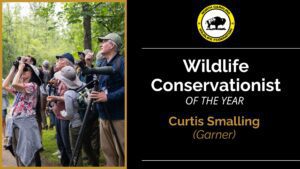
“In the past 20 years, Curtis has moved from a consultant to Audubon North Carolina to vice president and executive director of Audubon North Carolina.
He created and kick-started Audubon’s Bird Friendly Communities program more than a decade ago. He developed and launched Audubon’s first Urban Forestry program.
He’s a member of the steering committee for the NC Bird Atlas, and chair of the NC State Scientific Council Bird Committee.
He has spearheaded the work those groups do to identify and conserve wild bird habitats across the state.
I invite you to please join me in blaming Curtis Smalling for all the amazing things he has done for North Carolina wildlife.
He is the 2026 Wildlife Conservationist of the Year.”
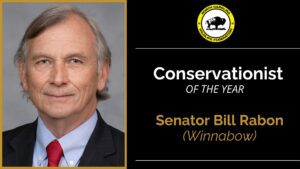
“You know the old saying: If you can’t take the heat, then you better get out of the North Carolina General Assembly. We are grateful that Senator Bill Rabon can take the heat, and that he’s been cooking up conservation advocacy for his eight terms in the NC Senate.
He’s been an advocate for conservation funding with the state’s trust funds, a champion for wildlife crossings, and a proponent of native plants for native wildlife. Most recently, Sen. Rabon took the heat for efforts to finally put inshore shrimp trawling on ice in North Carolina. As many of us are aware, North Carolina is the last state on the eastern seaboard to allow large-scale bottom trawling in inside waters – those estuaries such as Pamlico Sound that serve as nursery areas to a vast array of marine life.
The commercial fishing industry in North Carolina has a death grip on our ability to restore saltwater fish species to anywhere near their future abundance in this state. Rabon faced withering fire, and stood up to an incredible onslaught of mistruths and vitriol. His willingness to go to bat for the public trust resources of our coastal environment earned him scorn from some, but praise and gratefulness from so many who understand that North Carolina is squandering millions in potential revenue gained from rebuilt fish populations, and millions of memories from its citizens who are tired of waiting for North Carolina to step up and do the right thing in our coastal sounds.
Senator Bill Rabon is the 2026 Conservationist of the Year.”
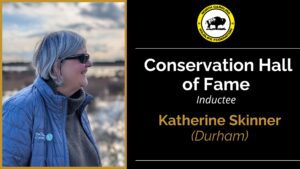
“Many of you know Katherine, and you know that she has served as executive director of The Nature Conservancy in North Carolina for four decades. Katherine Skinner’s legacy as executive director of The Nature Conservancy in North Carolina has been a tenure of nearly unparalleled action.
Under her leadership, TNC protected outright more than 460,000 acres and contributed to another three quarter of a million acres conserved statewide. Many of the legacy projects and programs she touched are now beloved landscapes and critical programs in North Carolina bear her mark: Among them, the Roanoke River Corridor and funding platforms such as the Natural Heritage Trust Fun, the NC Land and Water Fund, and the Parks and Recreation Fund.
Katherine, in fact, grew up on the Roanoke, in little ol’ Williamston, NC. She earned an undergraduate degree and then an MBA. Then she learned to run with the big dogs in boardrooms and backrooms in Washington, DC, where early in her career she was an aide to another legend of NC conservation, Congressman Walter B Jones, Sr. That was in the James Watt era, another time period that was particularly challenging for conservation interests, and she honed a philosophy of pragmatism and passion that has made such an impact on North Carolina.
It’s too easy to look at the infrastructure of conservation in North Carolina and take it for granted. But there wasn’t always a Roanoke River National Wildlife Refuge. Longleaf pines weren’t always revered as landscapes of biodiversity. Panthertown Valley, Mountain Bogs National Wildlife refuge, millions in Climate Pollution Reduction Grants coming to North Carolina – of all these came to be in part because of Katherine Skinner’s leadership.
A TNC staffer told me that Katherine is a “line of sight” leader. Establish a goal. Make a plan. Don’t get lost in the weeds. Inside the NC office of TNC there’s a line that describes the organization’s culture. TNC has a “strong bias for action.”
Please welcome Katherine Skinner as a 2026 inductee into the North Carolina Conservation Hall of Fame.”
Event Sponsors Support Conservation Heroes
Thank you to the following partners, businesses and individuals for helping us honor and celebrate North Carolina’s top-notch conservation leaders of 2026.
2026 Governor’s Awards Sponsors
Diamond Sponsors

Platinum Sponsors
John Robbins
Gold Sponsors
Grady-White Boats
Jordan Lumber
NC Electric Cooperatives
Silver Sponsors
Enbridge Gas
E&V Strategic Communications
James and Lauren Shaughnessy
Bronze Sponsors
DirectMail.com
Kilpatrick Townsend & Stockton LLP
Rutledge Family