


Working the Night Shift – Nocturnal Wildlife in North Carolina
Take a step outside on a misty, dew-drenched spring morning, and a group of robins might startle into flight as they root through the damp soil for earthworms.
In the bright light of afternoon, a green anole may be basking in the sun, nearly perfectly camouflaged against an oak leaf.
As the sun sets and the light begins to fade, the slow shadow of a white-tailed deer could appear along the edge of a field.
The variety of wildlife you might encounter during a normal day is vast, and we are fortunate to have so many species to witness in the daytime. But what often goes unnoticed are the wildlife that rarely – or never – emerge in the light of day.
These are the animals of the night: nocturnal wildlife.
Human eyes are not made for seeing in the dark, so we often miss species that are only active at night. But the blanket of darkness doesn’t mean wildlife isn’t moving. In fact, many animals are very active.
In this blog post, we’ll dive into some of North Carolina’s nocturnal wildlife species, how they have adapted to thrive in the dark, and how you might even be able to see them.
Nocturnal Wildlife and Adaptations
 There are generally seven different categories describing when wildlife is most active:
- Diurnal: most active in the daytime
- Crepuscular: most active in low light, typically at dawn and dusk
- Nocturnal: most active in the dark
- Cathemeral: active at various times throughout the 24-hour cycle, with no strong day/night preference
- Matutinal: most active in the early morning
- Vespertine: most active in the evening
- Ultradian: active in cycles shorter than 24 hours (e.g.,, animals that alternate between activity and rest several times a day)
That said, not all wildlife species fit neatly into one particular category. Some may fall into several categories, and their patterns can vary depending on environmental conditions. Season, habitat, temperature, predators, food availability, and human activity can all influence when and how much animals are active.
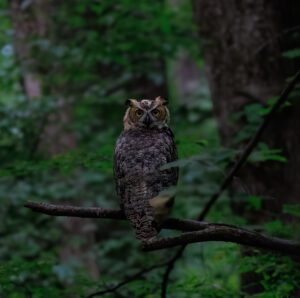
These patterns of activity are shaped by evolution and help species make the most of their ecological niche. For example, great horned owls are primarily nocturnal, and their behavior and physical traits help them hunt effectively at night. Hunting after dark allows this species to use darkness to their advantage when searching for prey such as mice, frogs, and small birds. Over generations, traits that make nighttime hunting more effective – including large eyes with many rod cells for detecting movement in low light, excellent hearing aided by their facial disk, and specialized feathers that allow nearly silent flight – have helped barred owls thrive as nocturnal forest predators.
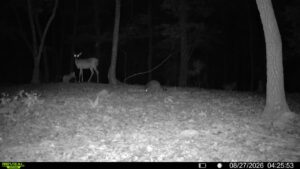
Trail camera image of tapetum lucidum in a whiet-tailed deer and common raccoon
Here are some more examples of adaptations nocturnal wildlife use to thrive in the dark:
The Tapetum Lucidum – A Mirror in the Dark
One of the most recognizable adaptations of many nocturnal animals is the tapetum lucidum, a reflective layer located behind the retina. This structure acts like a mirror, reflecting light back through the eye after it passes through the retina. The reflected light gives photoreceptor cells a second opportunity to detect it, improving vision in very dim conditions.
You may have noticed the tapetum lucidum while driving or walking outdoors with a flashlight, when you catch the glow of an animal’s eyes in the dark. Common wildlife species with a tapetum lucidum include white-tailed deer, raccoons, opossums, black bears, coyotes, and alligators.
Rod Cell Concentration and Density for Seeing in the Dark
Nocturnal animals often have eyes that are specialized for detecting very small amounts of light. Their retinas typically contain high concentrations of rod cells, which are highly sensitive to dim environments and movement.
Rod cells allow animals to detect shapes and motion even when there is very little available light. However, they provide less information about color and fine detail than cone cells, which play a larger role in the vision of many daytime animals.
For example, barred owls have retinas dominated by rod cells, with roughly 10 rods for every cone. Humans, by comparison, have about 120 million rods and 6 million cones in each retina, or roughly 20 rods for every cone. This high concentration of light-sensitive rod cells helps barred owls detect movement in low-light conditions where they hunt.
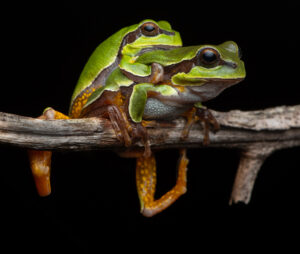
The large eyes of pine barrens tree frogs helps them to see in the dark. Photo by Shreyes Chalasani, NCWF Photo Contest Submission
Larger Eyes and Greater Light Collection
Many nocturnal species have large eyes relative to their body size. Larger eyes and pupils allow more light to enter, increasing the amount of light available for the retina to process.
This is why animals such as owls and cats often appear to have unusually large eyes. Their eye structure helps them collect as much available light as possible, making it easier to detect prey, navigate their surroundings, and recognize threats after dark.
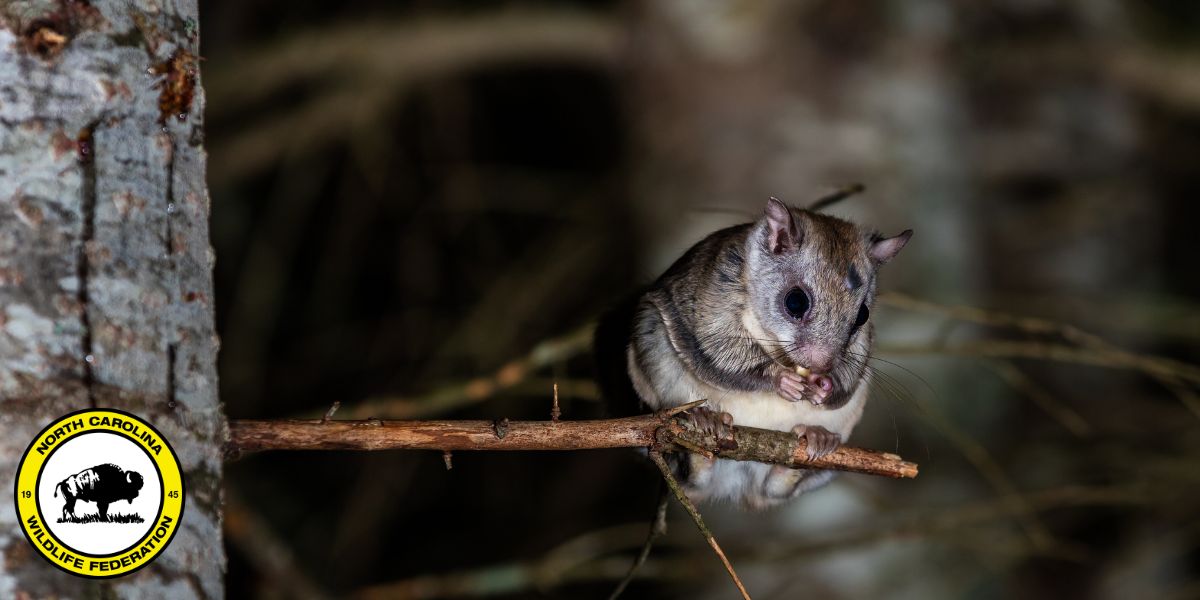
For instance, flying squirrels have disproportionately large eyes that help them navigate as they glide from tree to tree in the dark. Along with their enhanced vision, flying squirrels use skin flaps called a patagium to glide distances of up to several hundred feet.
Using Other Senses to Fill the Gaps
Nocturnal animals do not rely on vision alone. Because darkness limits what their eyes can detect, many species have developed stronger abilities in other senses.
Owls use highly sensitive hearing to locate prey even when they cannot see their prey clearly. Bats use echolocation to create a sound-based map of their environment. Many mammals, such as opossums and raccoons, rely heavily on smell and touch to find food and navigate their surroundings.
For many nocturnal species – though most can see better than humans in low light – perception is a combination of limited vision and information gathered through other senses.
How to Observe Nocturnal Wildlife
You don’t have to be an expert – or venture deep into the woods at midnight – to experience nocturnal wildlife. Sometimes, all it takes is a quiet walk, a little patience, and a willingness to listen.
If you want to look for wildlife after dark, start by walking slowly and quietly along an established trail or spending some time in your own yard. Listen for the calls of owls and frogs, watch for bats flying overhead, and keep an eye out for movement along the edges of fields, forests, and ponds.
A flashlight can be useful for safety, but try to keep artificial light to a minimum. If you need a light to navigate, a red light can help you see without disrupting your night vision as much. Avoid shining lights directly into an animal’s eyes or following an animal with a beam. Artificial light can interfere with the behavior and safety of many nocturnal species, so use light sparingly.
Most importantly, give wildlife plenty of space. Don’t approach, feed, bait, or handle them, and if an animal notices you or changes its behavior because of your presence, give it more distance.
And you don’t necessarily have to see an animal to know it’s there. Sometimes the rustle of leaves, the call of an owl, or the flash of a firefly is enough to remind us that even when we can’t see the animals, North Carolina is alive even after dark.
 Try a Wildlife Night
 Try a Wildlife Night
If you’re looking for a way to experience nocturnal wildlife, consider attending a moth night, such as those hosted by NCWF. These events are typically held at night and use lights and white sheets to attract moths, giving participants an opportunity to see and identify species that are rarely noticed during the day.
Moth nights can be surprisingly active. While you’re watching the sheet for moths, you may also spot other nighttime insects and wildlife nearby. Other nocturnal wildlife activities include bat nights, frog walks, and more – check out NCWF’s event calendar and subscribe to our events newsletter to stay in the know about these events.
Want to try a moth night yourself? A white sheet and a light can create a simple observation station in your backyard. Set it up in an area where you can watch from a comfortable distance, let the moths come to you, and see what appears.
Viewing moths is also a good way to observe smaller species. Some of the most fascinating wildlife may be so small that we fail to notice them in our everyday lives. Slowing down and paying attention to even the smallest creature around us can reveal an entire community that is easy to overlook.
Written by:

– Bates Whitaker, NCWF Creative Content Manager
– Dr. Liz Rutledge, NCWF VP of Wildlife Resources