

New Red Wolf Litters Offer Hope While Highlighting the Need for Connected Habitat
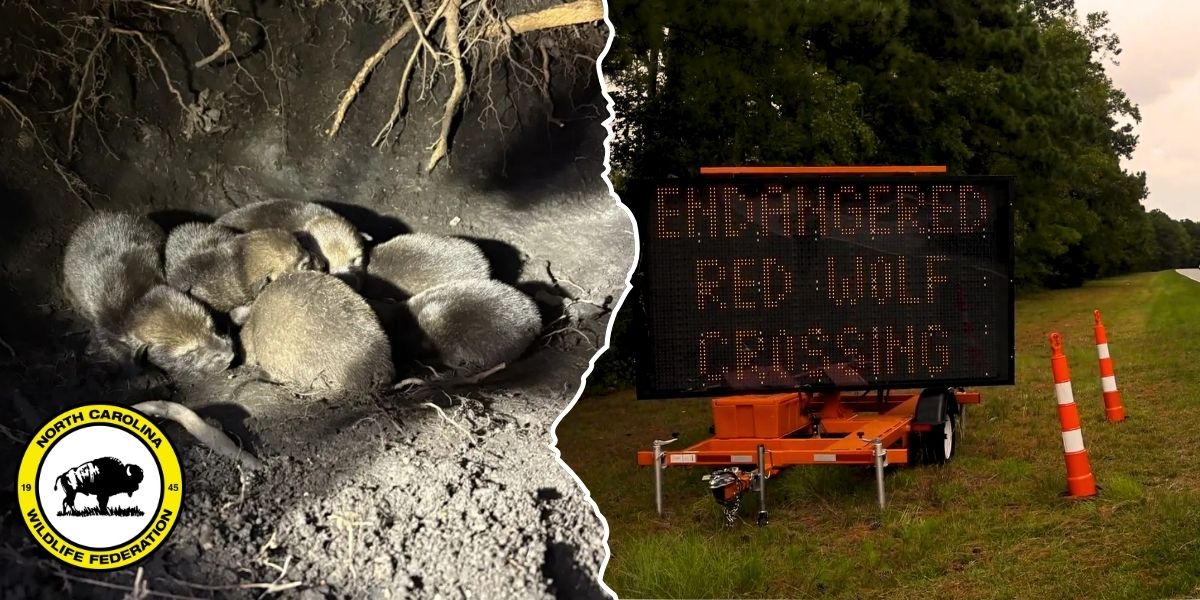
2026 Milltail litter in their den. (Photo: USFWS)
This spring, four litters of critically endangered Red Wolf pups were born in eastern North Carolina, marking an important milestone in the recovery of a species that once stood on the brink of disappearing from the wild. According to the U.S. Fish and Wildlife Service’s Red Wolf Recovery Program, there are 22 known and collared Red Wolves that now roam the landscape, joined this year by 12-16 surviving pups from the 2024/2025 breeding season.
While every litter represents hope, the future of Red Wolves depends on something much larger than successful births alone: support from the community, and connected landscapes that allow wildlife to safely move, disperse, and thrive. Habitat connectivity is essential for many wildlife species, but that challenge is especially urgent for Red Wolves.
Since 2020, vehicle collisions have become the leading documented cause of Red Wolf mortality. Eight wolves have been confirmed to be killed by vehicles in the past six years, nearly all along U.S. Highway 64, which cuts through the heart of the recovery area surrounding Alligator River and Pocosin Lakes National Wildlife Refuges. In light of this clear and present threat to Red Wolf recovery, it is important to implement innovative solutions to address the issue of habitat fragmentation.
Update From the US Fish & Wildlife Service Red Wolf Recovery Program
Unfortunately, we do not have good news to share with this update. On July 30th, 2503F, the breeding female for the Milltail family group for the last two years, was hit by a car and killed on Highway 264 in the middle of the night. It is a stark reminder that even mature Red Wolves born in the wild, who grew up knowing this landscape and do not frequent highways, are still vulnerable to what has become the leading cause of mortality of Red Wolves in the Eastern North Carolina Red Wolf Population (ENC RWP).
Fortunately, the two pups from this year’s litter were over 17 weeks old at the time of their mother’s mortality and had stopped nursing 7-9 weeks prior to that. Their father (2191M) continues to help raise them, as do their 5 older siblings (2660M, 2663M, 2664F, 2666F and 2667F) that are still with the family group. We are continuously monitoring the family group to see how this loss impacts their cohesiveness, and if we will start seeing dispersal of the yearlings or if a new breeding pair will start to form in this area. All information stemming from this monitoring will inform future management decisions.
2503F was born in the Milltail area in 2023. When she was just shy of 2 years old, she pushed her mother, 2225F, out as the breeding female and paired with 2191M who had been released from the SAFE (Saving Animals from Extinction) American Red Wolf program the previous year. She had 2 litters totaling 14 pups over the last 2 years.
The death of any part of a breeding pair is a significant loss, both to the family group and to the population as a whole, particularly with so few Red Wolves remaining on the landscape. It serves as a reminder: Please drive carefully throughout Eastern North Carolina, particularly at night and where you see mobile traffic signs indicating the presence of Red Wolves. Traveling with caution in these areas and slowing down for Red Wolves—and all wildlife—is one very real way you can make a positive difference.
Wildlife Crossings and Red Wolves
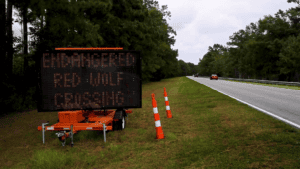 Wildlife crossings are one solution to addressing the need for Red Wolf habitat connectivity.
North Carolina has already demonstrated their value. In 2006, the state’s first comprehensive wildlife underpasses were constructed along a newly built section of U.S. Highway 64 in Washington County after biologists identified key crossing locations for Red Wolves and other wildlife. Today, state agencies continue working together to expand wildlife crossing infrastructure across North Carolina, helping reduce collisions while reconnecting fragmented habitat – and the implementation of these crossings just reached a historic milestone.
With the finalization of the state budget, lawmakers approved a historic $10.2 million in recurring funding for the North Carolina Department of Transportation’s Wildlife Highway Crossing and Mitigation Strategies Program. This marks the first time North Carolina has dedicated recurring funding specifically for wildlife crossings, creating a long-term investment that will benefit wildlife, motorists, and the state’s natural heritage for years to come. This includes considerations for more wildlife crossings for Red Wolves and other wildlife in eastern North Carolina.
Private Lands As Essential Element of Red Wolf Habitat Connectivity
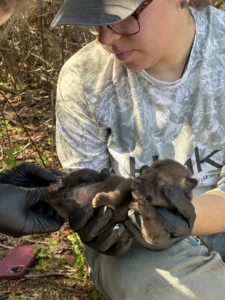
USFWS biological technician Caitlynn Overton holds a pup to determine it’s sex and conduct a general physical exam. (Photo: USFWS)
Private lands continue to play an equally important role in Red Wolf recovery.
Two of this year’s litters were born on private property, demonstrating how voluntary conservation partnerships, like Prey for the Pack, can directly support one of North America’s most endangered mammals. One breeding pair, both originally born in the SAFE population before being released into the wild, successfully raised their first wild-born litter on private land, illustrating the long-term success that can result from collaborative recovery efforts.
With most land in North Carolina privately owned, healthy wildlife populations depend on landowners who choose to steward habitat and maintain connected landscapes. Through partnerships with the U.S. Fish and Wildlife Service’s Partners for Fish and Wildlife Program, North Carolina Wildlife Federation works with landowners to restore habitat that benefits both wildlife and working lands.
One of those efforts is Prey for the Pack, a voluntary program that helps private landowners improve habitat across the Albemarle-Pamlico Peninsula. Participants receive technical and financial assistance for habitat restoration projects that create better cover, food resources, and movement corridors for wildlife – including Red Wolves – while supporting their own land management goals.
Hope in the Road Ahead
Although pup mortality remains a natural part of Red Wolf ecology, the births this spring provide cautious optimism. Several litters have experienced losses, which is not uncommon, as approximately half of the Red Wolf pups born do not survive to their first year of life. Even so, the surviving pups represent the next generation of a population fighting its way back from the edge of extinction.
Every successful litter, every restored acre of habitat, every willing landowner, and every safe wildlife crossing strengthens the connections that Red Wolves need to survive.
Recovery doesn’t happen in isolated places. It happens when landscapes, people, science, and wildlife remain connected.
Written by:
– Katerina Ramos, NCWF Red Wolf Education & Outreach Coordinator

– Bates Whitaker, NCWF Creative Content Manager