


Wildlife Scavengers: Nature’s Cleanup Crews
When we think of wildlife, we often picture songbirds, squirrels, maybe some pollinators, or the ever-present white-tailed deer – species that, in spite of significant changes to their habitats in urban areas, have adapted to human-dominated landscapes. They are familiar faces in our backyards, parks, and even along busy streets.
But there is another group of animals living quietly among us – often overlooked and misunderstood – that play an essential role in keeping our shared environment healthy: the scavengers.
The Role of Scavengers
Scavengers are nature’s sanitation workers. They feed on dead animals (carrion), breaking down what would otherwise remain and rot in our communities and natural spaces.
It is easy to see why they are needed. In 2008, the Federal Highway Administration estimated that roughly 365 million vertebrate animals are killed on U.S. roadways every year – about a million every day. With road expansion continuing, the actual number today may be even higher (Federal Highway Administration).
While this high mortality rate is concerning, it also creates a constant – and essential – demand for scavengers. Their job doesn’t stop at roadkill, either. Scavengers help decompose any dead organic matter they find, working solo or together as part of a diverse cleanup crew.
This decomposition process serves multiple functions:
- Prevents the spread of disease and bacteria
- Reduces pollution in water and soil
- Recycles nutrients back into the ecosystem
North Carolina is home to a wide array of scavengers – from mammals and birds to reptiles and insects. Some are dedicated scavengers, others are opportunistic feeders, scavenging only when the moment arises. Here are just a few that help keep our environment clean.
Turkey Vultures and Black Vultures (Family: Cathartidae)
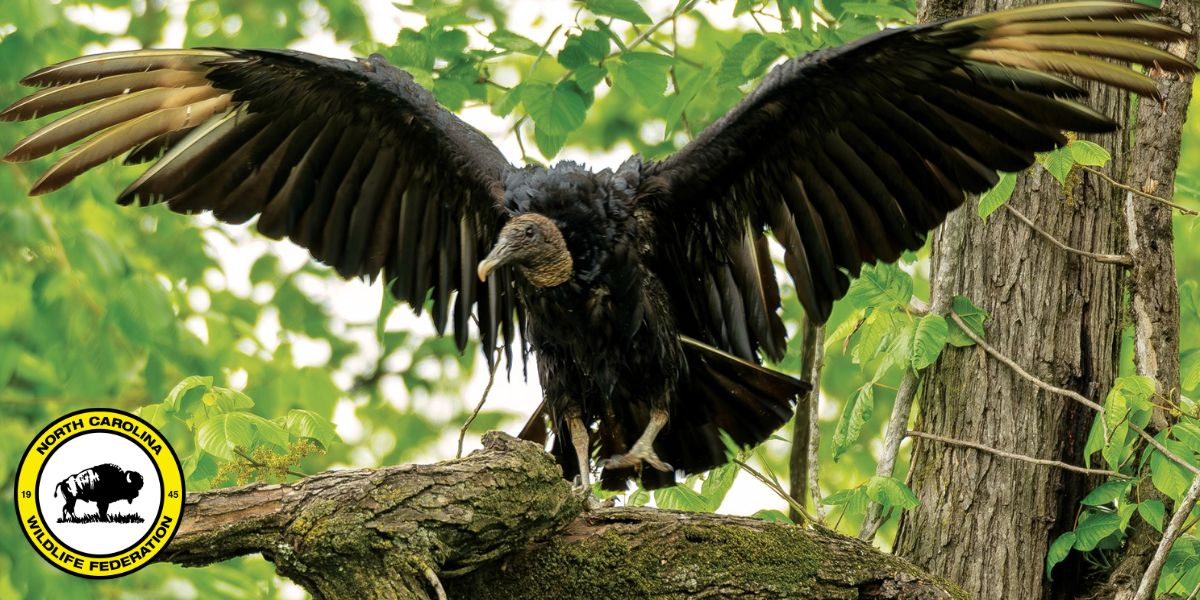
Turkey vultures and black vultures are among the most efficient scavengers found throughout North Carolina and much of the Americas. Adapted specifically for feeding on carrion, both species have powerful, hooked beaks that tear through tough animal hides. Their bald heads prevent feathers from becoming matted with blood and bacteria, helping them stay clean while feeding. Turkey vultures are easily identified by their dark brown bodies and bright red, turkey-like heads, while black vultures sport black plumage and darker grayish heads. Social creatures by nature, these vultures roost communally in large groups and nest in hidden places such as hollow trees, caves, rock ledges, or even abandoned buildings, which provide shelter and protection from predators.
Vultures are vital for ecosystem health because of their ability to rapidly locate and consume carcasses, sometimes traveling dozens of miles daily using their keen sense of smell and sight. By consuming dead animals quickly, they reduce the risk of disease transmission caused by decaying flesh, such as anthrax or botulism (World Wildlife Fund). While carrion is their primary food source, vultures occasionally eat trash, fish, and small live prey, demonstrating adaptability in changing environments. Despite historical threats from poisoning, habitat destruction, and lead contamination, populations of both turkey and black vultures remain stable and are currently classified as species of low conservation concern, continuing their critical role in waste removal and nutrient recycling.
American Crow (Corvus brachyrhynchos)
The American crow is one of the most familiar and adaptable birds across North Carolina’s varied landscapes, including urban areas, forests, and farmland. Renowned for their high intelligence, crows exhibit complex social behaviors, including strong monogamous pair bonds and cooperative breeding strategies. They are opportunistic omnivores, consuming a wide diet that includes seeds, insects, eggs, small animals, and carrion. Their loud, distinctive cawing and preference for nesting in evergreens make them a common sight in many habitats.
As scavengers, American crows play an essential role in ecosystem health by cleaning up carrion and human-generated waste. Their adaptability to human-dominated environments has allowed them to thrive, maintaining stable populations despite habitat changes. Additionally, crows contribute to seed dispersal and pest control, making them important ecological players beyond their scavenging role. Their presence across North America showcases the success of versatile species in both natural and urban settings.
Common Snapping Turtle (Chelydra serpentina)
Though often overlooked as scavengers, common snapping turtles are critical aquatic decomposers. These turtles inhabit ponds, lakes, and slow-moving rivers, favoring muddy bottoms rich in vegetation. Equipped with powerful jaws and a strong bite force, snapping turtles feed on a diverse diet that includes aquatic plants, live fish, amphibians, and carrion. Their scavenging behavior helps keep water bodies clean by consuming dead or dying animals, thus limiting nutrient buildup that can lead to algal blooms and oxygen depletion (Santori et al).
Female snapping turtles move onto land each spring to lay nests containing 11 to 38 eggs. This terrestrial journey puts them at significant risk of road mortality, one of the leading threats alongside habitat loss and overharvest of snapping turtles for food. Despite these challenges, snapping turtles remain widespread and are currently listed as a species of low conservation concern. Their role in aquatic ecosystems as both predator and scavenger helps maintain a balanced food web and supports healthy water quality.
Carrion Beetles (Family: Silphidae)
Carrion beetles are among the most efficient decomposers in many ecosystems, playing a vital role in breaking down dead animals and recycling nutrients back into the soil. These beetles have an extraordinary ability to locate carcasses within hours of death, using their highly sensitive sense of smell to detect chemical cues released during decomposition. Some species, like the burying beetles (Nicrophorus genus), take this a step further by burying small carcasses to create a protected site where they lay their eggs (Entomology Today). Their larvae then feed on the carcass, accelerating decomposition and nutrient cycling while reducing competition from other scavengers.
Beyond just recycling nutrients, carrion beetles contribute to limiting the spread of disease by quickly disposing of decaying material that could harbor harmful pathogens. They also produce antimicrobial secretions that help suppress bacteria, slowing the growth of harmful microbes during decomposition (Hall et al.).
Blow Flies (Family: Calliphoridae)
Blow flies are often the first scavengers to arrive at a fresh carcass, making them essential players in the decomposition process. These flies are attracted to dead animals within minutes by detecting volatile organic compounds released during the early stages of decay (Martin et al.). Their metallic blue or green bodies are a common sight around carrion. Females lay eggs almost immediately, and the resulting larvae – commonly known as maggots – hatch quickly to consume decaying tissues with impressive efficiency.
Blow flies thus perform the first step in a crucial sanitation role, supporting a complex community of scavengers that follow in the later stages of decomposition. Beyond their ecological importance, blow flies are also valuable in forensic science, helping estimate time of death in criminal investigations due to their predictable life cycles (UK Natural History Museum).
Written by:

– Bates Whitaker, NCWF Creative Content Manager