


Stranger Than Fiction: Reframing the “Weird” and “Disturbing” in Wildlife
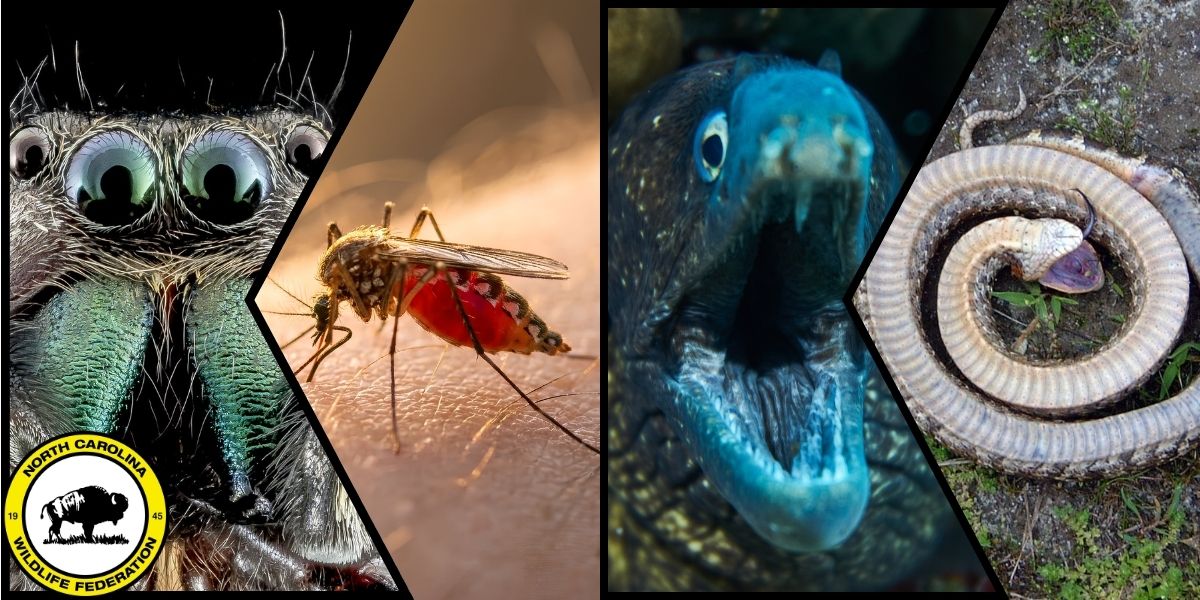
When movie directors want to invent terrifying monsters, they usually start with basic horror tropes: creatures that regenerate lost limbs, spray toxic chemicals, live inside host bodies, control minds, or feed on blood.
These tropes are not drawn from thin air – many of them are inspired by real adaptations in real-life species.
Our state is home to species with behaviors and techniques that sound like pure science fiction. Yet these behaviors aren’t signs of “bad” or “scary” animals – they are remarkable evolutionary adaptations that help wildlife survive in a challenging world. In this blog, we’ll take a look at some of North Carolina’s strangest natural phenomena.
Wildlife Mimicry in Action
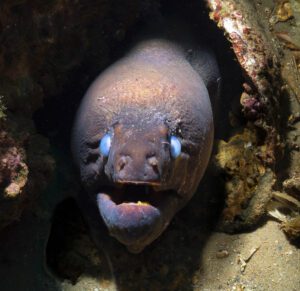
Moray eel by Elizabeth Sommers, NCWF Photo Contest Submission
The act of taking inspiration from wildlife species to create characters in horror movies is an art similar to biomimicry – the practice of learning from nature’s strategies, forms, and ecosystems to solve human design and engineering challenges.
Biomimicry, however, seeks to solve human challenges by drawing inspiration from nature – whether modeling aircraft after birds’ flight or developing water-repellent clothing inspired by the unique properties of cicada wings.
The practice of engineering fictional monsters, aliens, or cyber-organic beasts by directly emulating the structural, functional, and behavioral adaptations found in real-world nature is instead referred to as a form of biomimetic design to reimagine fictional creatures.
For example, the concept of the Xenomorph in the horror movie Alien mimics the parasitoid reproductive cycle of Ichneumonidae wasps (which inject eggs into hosts) and features a pharyngeal jaw directly modeled on the hydraulic, snapping jaws of moray eels.
While the practice of biomimetic creature design in our lore and horror movies is both entertaining and captivating, it can often lead to a misunderstanding of these traits in wildlife species and reinforce an aversion to or fear of them. Let’s break down some of these seemingly outlandish wildlife adaptations, how they work, and how they are useful to a variety of wildlife species.
1. Animals That Can Regrow Body Parts

Crayfish regrowing lost claw
Losing a limb can be catastrophic for humans, but for certain wildlife species, it’s sometimes merely a temporary setback.
The Eastern newt – and several other native salamander species – possesses the ability to regenerate entire limbs, tails, eyes, and even parts of their heart and brain tissue. Unlike human healing, which leaves behind fibrous scar tissue that makes it impossible to regenerate limbs, a salamander can completely rebuild complex biological elements down to the bones, nerves, and blood vessels.
Similarly, skinks, anoles, and glass lizards have the ability to utilize caudal autotomy, a predator distraction technique that enables them to drop their tails. Once severed, the tail has the ability to continue to move, allowing the animal to escape to safety.
Other native creatures share regenerative traits on a smaller scale. Crayfish and crabs can replace lost claws during subsequent molts, and spiders can regrow missing legs over time. Scientists have intensively studied these species and their regenerative abilities, hoping that understanding their biological machinery might one day unlock advances in human regenerative medicine.
2. Playing Dead – and Why It Actually Works
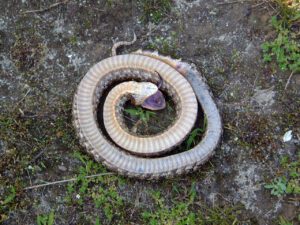
Hognose snake playing dead (Photo: USFWS)
Thanatosis, or death-feigning behavior, is best demonstrated by the Virginia opossum. When confronted by a severe threat, an opossum doesn’t make a conscious decision to put on a dramatic performance. Instead, its body undergoes an involuntary reflex: its heart rate slows dramatically, its body goes limp, its mouth gapes open, and it secretes a foul-smelling fluid from its anal glands.
Similarly, Eastern hognose snakes may roll onto their backs with their mouths open, feigning death. Even when flipped over, they may roll back onto their backs and continue the act.
To a predator looking for fresh prey, a stiff, cold, foul-smelling animal may instantly lose its appeal. Many carnivores are instinctively wired to avoid eating carrion to protect themselves from disease.
3. Weaponizing Their Own Bodies

Puss caterpillar by M. Merchant
Wildlife doesn’t rely solely on claws and teeth for self-defense. Sometimes, an animal’s entire physical makeup is built as a defensive mechanism.
- Chemical Defense: Striped skunks can accurately spray a sulfur-rich musk at predators from up to 10–15 feet away, leaving a smell that can last for weeks and teaches predators to keep their distance.
- Venom versus Poison: Venom differs from poison in that venom is injected through a wound and poison is either absorbed, ingested, or inhaled.
For example, venomous snakes like copperheads and rattlesnake species in North Carolina use specialized venom delivered through hollow fangs. Red-spotted newts, however, secrete poisonous toxins from their skin to deter predators. - Irritating Armor: While often appearing fuzzy and unassuming, some caterpillars like the puss caterpillar – the larval stage of the Southern flannel moth- carry stinging, hollow spines packed with toxins that cause painful rashes on anything that tries to grab them.
4. Animals That Live Inside Other Animals

Ichneumonid wasp by USGS Bee Lab
North Carolina hosts a vast array of parasites and parasitoids. While the word “parasite” might bring to mind leeches or ticks, the relationship takes many forms:
- Parasites: Organisms that live on or inside a host, consuming resources without immediately killing the host (such as parasitic worms or aquatic leeches).
- Parasitoids: Organisms that ultimately kill their host as part of their development.
For instance, certain species of solitary wasps track down caterpillars or spiders, sting them into paralysis, and lay eggs inside or on their bodies. As the wasp larvae develop, they consume the host from the inside out, ensuring the next generation of wasps survives while the host perishes. Some species such as ichneumonid and braconid parasitic wasps even inject types of polydnavirus alongside their eggs, which regulates the physiology of the host during the development of larval wasps.
5. Animals That Eat Their Own Kind
Cannibalism often seems like the ultimate taboo in human society, but in the animal kingdom, it’s a real response to specific ecological stress and pressures.
Cannibalism, though rare in many cases, has been documented across many classes of wildlife species. It typically occurs under specific circumstances:
- Resource Scarcity: When food becomes scarce, eating a competitor provides immediate nourishment while reducing local competition. Tadpoles have been recorded to eat one another in the scarcity of other food sources.
- Mating Dynamics: Sexual cannibalism – where one partner consumes the other during or after mating – provides vital nutrients that help produce healthy eggs. For example, this type of cannibalistic behavior can occur in praying mantises and many spider species.
- Size Disparities: Larger individuals will sometimes prey on smaller juveniles simply as an easy meal.
While to us, this behavior can seem “evil” or an “unnatural behavior” in the wild, wildlife cannibalism is actually a functional strategy that balances population density and energy needs.
6. The Truth About Bloodsuckers

Mosquitos full of ingested blood (Photo by Patti Peterson)
Halloween lore is full of vampire stories, but North Carolina’s real blood-feeders are much smaller and far more common.
Mosquitoes, ticks, and leeches have all evolved blood-feeding (hematophagy) independently. Blood is an extraordinarily dense source of proteins and lipids. Only female mosquitoes consume blood, using the nutrient boost to develop their eggs.
Specialized enzymes in their saliva prevent blood clotting and numb the bite area, allowing them to feed unnoticed. Additionally, some research is emerging that some mosquito species are adapting enzymes to protect against certain insecticides. While humans may find them annoying or painful, mosquitoes are integral components of wildlife food webs, providing critical food for birds, bats, fish, and amphibians.
Conclusion: The “Weird” Is the Point
Hollywood spent decades coming up with alien monsters and supernatural creatures, but nature got there first.
Regeneration, death-feigning, chemical weaponry, parasitism, cannibalism, host manipulation, and blood-feeding aren’t signs of “scary” or “bad” wildlife. They are incredible ways that animals have adapted to survive in competitive environments.
Next time you notice or learn about a wildlife behavior that may seem unsettling or frightening to us as humans, ask yourself: What pressure in evolution shaped that bizarre behavior? How might it benefit these species?
When we look past our initial reactions and fears, we can find that these adaptive behaviors are more than something akin to jump scares from a horror movie – they reveal the ingenuity of nature and the incredible ways wildlife has evolved to survive.
Written by:

– Bates Whitaker, NCWF Creative Content Manager
– Dr. Liz Rutledge, NCWF VP of Wildlife Resources