


Heat of the Hunt: How Predators Hunt Their Prey
It’s one of those warm summer evenings in the North Carolina woods. Humidity hangs in the air, and the last rays of sunlight filter through the forest canopy. The chorus of daytime birds begins to fade, replaced by the steady hum of crickets and katydids. Nearby, a gray squirrel gathers one final acorn before heading back to its nest.
And in a tangle of fallen logs and branches, something is hunting.
A bobcat crouches low to the ground, its spotted coat blending into the shadows. Slowly, it inches forward. Ten yards. Seven yards. Six.
Then the stillness breaks. A squirrel high in the canopy sounds an alarm call. The squirrel on the ground freezes, standing upright as it searches for danger.
The bobcat lunges.
Leaping into the air with a burst of incredible speed, it clears the deadfall and lands on its unsuspecting prey. And just like that, the hunt is over.
Have you ever watched a hawk circling high overhead before suddenly dropping toward the ground? Or noticed a bat darting through the evening sky, catching insects too small and fast for us to see?
Maybe you’ve spotted a spider waiting motionless in its web or watched a dolphin surface offshore before disappearing beneath the waves again.
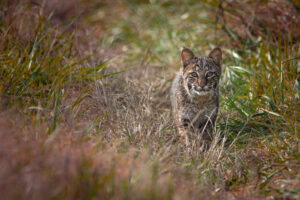
Bobcat (Lynx rufus) by Mason Maron, NCWF Photo Contest Submission
From forests and fields to rivers and coastal waters, predators have evolved an incredible variety of ways to find their next meal. In this blog post, we’ll explore several hunting strategies used by wildlife in North Carolina and meet some of the species that have mastered the art of the hunt.
Why Do Animals Hunt Differently?
In prehistoric oceans, the earliest animal life forms were simple multicellular organisms that fed in a variety of ways, including filtering particles from the water and grazing on microbial mats. As animal diversity increased, different feeding strategies emerged in parallel. Some lineages developed predatory behaviors, feeding on other animals or protists, while others evolved herbivory, consuming algae and photosynthetic organisms. Rather than appearing in a strict sequence, carnivory and herbivory likely evolved repeatedly and independently as ecosystems became more complex.
Over time, as life expanded into more varied environments, animal diets diversified further into the major feeding strategies we see today, including carnivory, herbivory, omnivory, scavenging, and filter feeding. Carnivorous animals obtain energy by consuming other animals, and they exhibit a wide range of adaptations that make this possible – from active pursuit and ambush hunting to specialized sensory systems and opportunistic feeding behaviors. These adaptations reflect the many different ecological roles predators occupy, rather than a single unified method of hunting.
Finding food is one of the most important parts of survival. The way an animal hunts is often shaped by where it lives, what it eats, and the challenges it faces in its environment. Though certain species may primarily utilize a specific hunting strategy, many use a combination of strategies to best suit whatever hunting situation they find themselves in.
Here are a few common hunting strategies used by species in North Carolina.
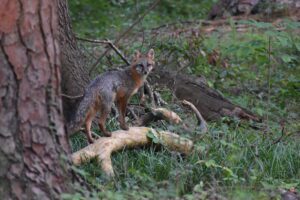
Gray fox (Urocyon cinereoargenteus) by Bridgett Aguirre, NCWF Photo Contest Submission
Pursuit Hunting
Some predators actively chase prey. These animals rely on speed, endurance, or agility to catch animals attempting to escape.
Examples of species in North Carolina:
- Coyote – pursues rabbits, rodents, and other small animals
- Gray Fox – uses quick bursts of speed to catch small mammals
- Striped Bass – actively chases schools of fish in rivers and coastal waters
- Dragonfly – captures insects while flying at high speed
Ambush Hunting
Other predators conserve energy by remaining hidden and waiting for prey to come within striking distance. Success depends on patience, camouflage, and precise timing.
Examples of species in North Carolina:
- Copperhead – relies on camouflage to surprise rodents and other prey
- Eastern Diamondback Rattlesnake – waits concealed for passing prey in coastal habitats
- Fishing Spider – remains motionless near water before striking insects or small aquatic animals
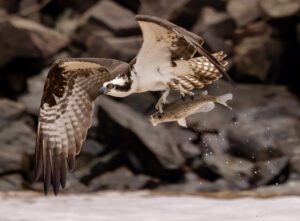
Osprey (Pandion haliaetus) with crappie by Mark Gallerani, NCWF Photo Contest Submission
Aerial Hunting
Many birds catch prey from above, using sharp eyesight and powerful flight to locate and capture prey in the air, on the ground, or in the water.
Examples of species in North Carolina:
- Red-tailed Hawk – scans open areas for rodents and rabbits
- Barn Owl – hunts rodents over fields and grasslands
- Osprey – dives into water to capture fish
Scavenging and Opportunistic Feeding
Not all predators hunt every meal. Some species take advantage of whatever food sources are available, including carrion, insects, fruits, or human-generated food sources.
Examples of species in North Carolina:
- Raccoon – consumes a wide variety of plant and animal foods, including nest eggs.
- American Crow – eats insects, small animals, carrion, and human food scraps.
- Black Bear – opportunistically feeds on fruits, insects, carrion, and other available foods – in addition to deer, other mammals, and more.
How Predators Find Their Food
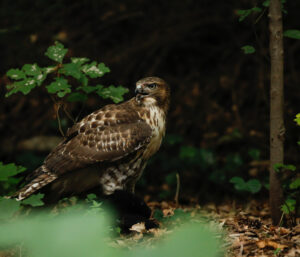
Hawk with prey by Corrie Woods, NCWF Photo Contest Submission
Predators rely on a variety of adaptations to locate prey.
Adept Vision
Hawks, falcons, and owls have highly developed eyesight that allows them to spot prey from remarkable distances. For example, red-tailed hawk eyes contain a high density of light-sensitive cells and specialized regions of the retina that provide exceptional visual acuity, allowing the hawks to detect small prey such as mice, voles, and rabbits from hundreds of feet away. Humans have one fovea (the area of the retina that provides sharp, clear vision) in each eye. Hawks have two, allowing them to focus on prey directly in front of them while maintaining hyper-focused peripheral vision simultaneously.
Examples of species in North Carolina:
- Red-tailed Hawk
- Cooper’s Hawk
- Bald Eagle
Sensitive Hearing
Many predators can detect faint sounds made by hidden prey. Owls, for example, can locate small mammals moving beneath leaves or vegetation. They possess one of the most acute hearing systems of any bird. Its facial disk of stiff, specialized feathers acts like a sound collector, funneling noises toward its ears. Unlike most birds, an owl’s ears are positioned asymmetrically on its head, allowing it to determine both the direction and elevation of a sound with remarkable precision. Owl ears are fundamentally superior to human ears in three main ways: they are about ten times more sensitive at specific frequencies, they act as highly specialized three-dimensional sound locators, and – unlike humans – they do not deteriorate with age.
Examples of species in North Carolina:
- Barn Owl
- Barred Owl
- Eastern Screech-Owl
Echolocation
Echolocation is a biological sonar system used by certain species to locate prey in environments where vision is limited, such as darkness or murky water. Animals that utilize echolocation emit high-frequency sounds that travel through their surroundings and bounce off objects, including potential prey. By interpreting the returning echoes, they can determine an object’s distance, direction, size, shape, and even movement in real time. This creates a highly detailed “sound map” of their environment, allowing them to navigate and hunt with precision, even when visibility is near zero.
In North Carolina, echolocation is used by numerous bat species, which rely on this sensory technique to hunt flying insects at night, and by bottlenose dolphins, which use it to locate fish, squid, and crustaceans in coastal and estuarine waters. In both cases, echolocation allows these predators to find food sources that would otherwise be difficult or impossible to find using vision alone.
Examples of species in North Carolina:
- Numerous bat species
- Bottlenose dolphins
Diving Deeper Into Some Predator Species
Bats
Bats are incredibly diverse and ecologically important creatures despite their reputation as being spooky or dangerous. They are often misunderstood and misrepresented in popular culture. Even so, bats provide many benefits including insect control, supporting cave ecosystems through guano production, and are prey species to other wildlife.
Hunting Strategies
Echolocation and Aerial Insect Hunting
As noted above, bats use a remarkable sensory system called echolocation to navigate and hunt at night. As they fly, bats produce rapid bursts of high-frequency sound – often at frequencies far above the range of human hearing. These sound waves spread through the environment and bounce off nearby objects such as trees, buildings, and insects. By listening to the returning echoes, a bat can determine an object’s location, size, shape, distance, and direction of movement in a fraction of a second. The bat’s brain processes this information so quickly that it effectively creates a detailed acoustic map of its surroundings, allowing it to fly through complex habitats without colliding with obstacles.
Echolocation is especially valuable for hunting insects in complete darkness. As a bat closes in on prey, it increases the rate of its calls, producing a rapid series of sounds known as a “feeding buzz.” This provides increasingly precise information about the insect’s position and movement, helping the bat make last-second adjustments during pursuit. Some bats are capable of detecting prey as small as mosquitoes and can even distinguish between different types of insects based on the echoes they produce. This sophisticated system allows bats to exploit nighttime food sources that are unavailable to many other predators, making them among the most successful nocturnal hunters in North Carolina’s forests, wetlands, and urban environments.
Eastern Copperhead
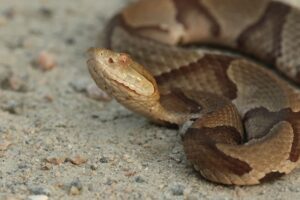
Eastern copperhead (Agkistrodon contortrix) displaying pit organs by H. Allan White, NCWF Photo Contest Submission
Eastern copperheads are one of North Carolina’s most common venomous snakes. Despite their reputation, they spend much of their time remaining hidden and waiting for prey.
Hunting Strategies
Heat Sensing and Ambush Hunting
Copperheads are a classic ambush predator that relies on patience, camouflage, and specialized sensory adaptations rather than speed to capture prey. Instead of actively searching for food, a copperhead often remains completely motionless for hours while waiting for an unsuspecting animal to pass within striking range. Its diet includes small mammals such as mice, as well as frogs, lizards, large insects, and other small animals. This hunting strategy allows the snake to conserve energy by minimizing movement and avoiding the need to pursue prey across long distances.
A copperhead’s success as an ambush hunter is enhanced by its exceptional camouflage and unique sensory system. The snake’s tan, copper, and chestnut-colored pattern blends remarkably well with fallen leaves and forest debris, making it difficult for both prey and people to detect. In addition, copperheads possess specialized heat-sensing pit organs located between the eyes and nostrils. These pits are essentially highly sensitive infrared detectors that allow the snake to “see” heat rather than light. Inside each pit is a thin membrane rich in nerve endings that responds to minute changes in temperature – sensitive enough to detect the faint infrared radiation emitted by warm-blooded animals such as mice, birds, or small mammals.
What makes this system especially useful as a predation feature is that it provides the copperhead with a kind of thermal “depth perception.” Because the snake has a pit on each side of its head, the brain can compare temperature signals from both sides to determine not only where a heat source is, but also its direction and relative distance. This allows the snake to accurately target prey even in complete darkness, under leaf litter, or in dense vegetation where vision alone would be ineffective.
Loggerhead Shrike
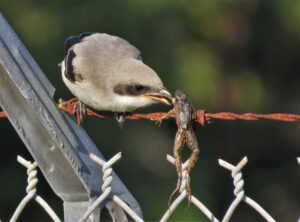
Loggerhead shrike (Lanius ludovicianus) by Susan Young
The loggerhead shrike is sometimes called the “butcher bird” because of its unusual hunting behavior.
Hunting Strategies
Perch Hunting and Food Storage
Loggerhead shrikes are a small songbird with the hunting habits of a much larger predator. Often called the “butcher bird,” the loggerhead shrike uses a hunting method called perch-and-pounce, scanning open fields and agricultural areas from fence posts, utility lines, or isolated shrubs. From these elevated vantage points, it watches for insects, small reptiles, rodents, and other prey before swooping in to intercept them.
Unlike hawks and falcons, loggerhead shrikes lack powerful talons for holding and dismembering prey. To compensate, they use sharp features in their environment as tools. After capturing prey, a shrike will often impale it on thorns, sharp branches, or barbed wire, creating a secure anchor that allows the bird to tear food into manageable pieces. These impaled prey items may also serve as food storage, enabling the shrike to return and feed later when hunting conditions are less favorable. This unusual behavior is rare among North American songbirds and demonstrates how the loggerhead shrike has evolved a unique solution to the challenges of capturing and consuming relatively large prey.
Dragonflies
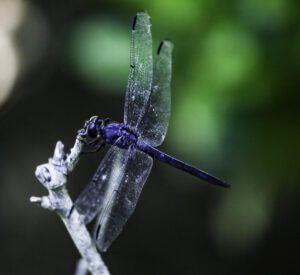
Dragonfly by Christopher Austin, NCWF Photo Contest Submission
Dragonflies are among the most skilled aerial predators. Although they are often seen resting near water on warm days, much of their life is spent in rapid flight as they hunt other flying insects.
Hunting Strategies
High-Speed Aerial Interception and Precision Vision
Dragonflies are highly efficient aerial hunters that – in their adult form – capture prey entirely in flight. Using extremely large compound eyes that can occupy most of its head, a dragonfly has nearly 360-degree vision and exceptional motion detection. This allows it to track moving insects – such as mosquitoes, gnats, and flies – with remarkable accuracy even in complex, fast-changing environments. Rather than chasing prey directly, many dragonflies use an interception strategy, predicting where a target will fly and adjusting their own flight path to meet it in midair.
Dragonflies are also capable of rapid acceleration, sudden turns, and hovering flight, all of which contribute to their hunting success. Once prey is captured, it is typically consumed mid-flight or carried to a perch for feeding. Because of their speed, agility, and visual precision, dragonflies are considered some of the most successful insect predators in North Carolina’s freshwater ecosystems, playing an important role in controlling mosquito and other insect populations.
Written by:

– Bates Whitaker, NCWF Creative Content Manager

– Dr. Liz Rutledge, NCWF VP of Wildlife Resources